The Ultimate SEO Guide for Estate Planning Lawyers

When someone searches for estate planning lawyers online, make sure your firm shows up.
That’s why Search Engine Optimization (SEO) is important.
While referrals remain a great way to get new business, relying on them exclusively leads to unpredictable monthly caseloads, putting a ceiling on your firm’s potential revenue. That’s why the most successful law firms invest in building a dominant organic search presence to ensure a steady stream of leads without ongoing ad spend.
In this post, we’ll break down how to optimize your digital footprint, maximize your organic visibility, and generate high-quality leads to grow your practice.
But first, a quick recap of the reason why you need SEO right now.
Why Estate Planning Lawyers Can’t Ignore SEO Anymore
Apart from referrals, families undergoing major life transitions conduct online research for a firm they can trust.
To be more precise:
- Shift in client research behavior: Even if your firm is referred by someone the client trusts, they still tend to check your credentials online through an online search. Optimizing your website ensures they find the information they need while also having an easy way to book a consultation.
- Capturing urgent intent triggers: Organic search allows your firm to be discoverable to potential clients when they’re in the right mood, like a health scare or retirement. It’s just a matter of targeting SEO keywords associated with commercial or transactional intent.
- Passive lead flow: Unlike digital advertising and most traditional marketing strategies, SEO doesn’t require ongoing investment to continue bringing in new leads. This allows you to explore other lead generation channels while your website works overtime in the background.
- Outranking local rivals: Earning top positions in local search results comes with an authority boost, helping you outshine local competitors with lower rankings. This is a crucial advantage for capturing the attention and business of high-net-worth families in your city.
With that out of the way, let’s talk about the SEO processes your estate planning law firm needs.
How to Optimize Estate Planning Law Firm Websites for Search
Here are the different components of a comprehensive SEO campaign for estate planning lawyers:
1. Local SEO and Google Business Profile Optimization
Local SEO is the process of building up your visibility for location-specific search keywords, like “estate planning lawyer Tampa Bay” or “estate planning lawyer near me.”
These keywords are used by prospects inside your area, making them perfect for attracting leads who are actually willing to walk into your office. They also bring up local search features that are highly effective in capturing attention, like the Google Local 3-Pack.
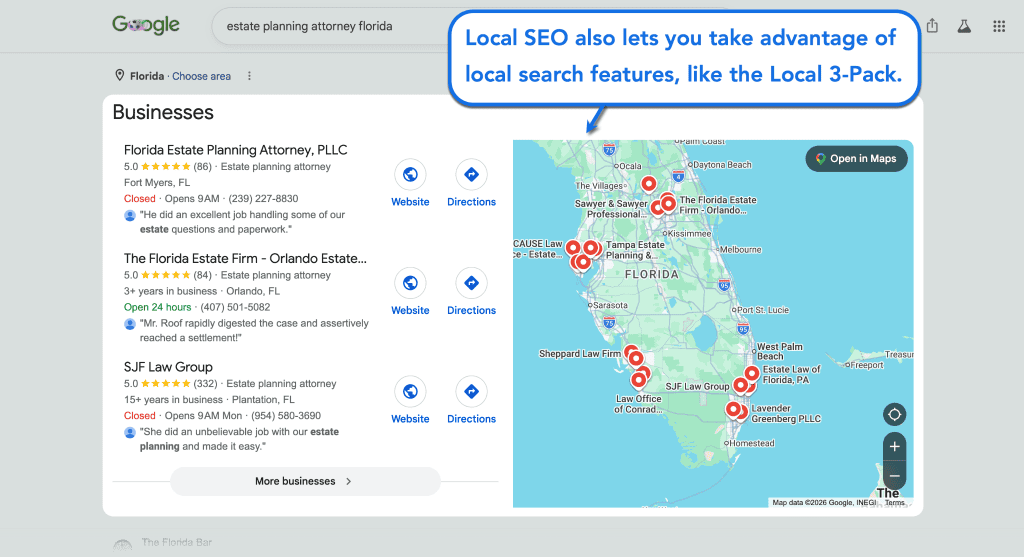
The first step towards local SEO is optimizing your Google Business Profile, establishing your local map presence.
Here are a few pointers you should remember:
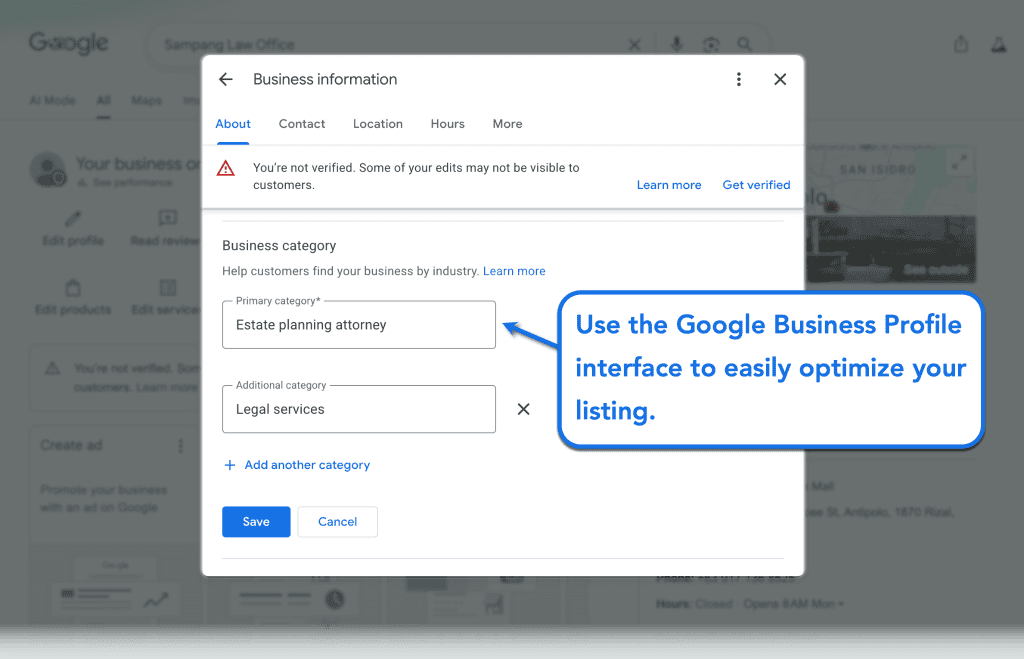
- Choose “Estate planning attorney” as your primary business category, then add relevant subcategories like “Lawyer” and “Legal services.”
- Use the exact Name, Address, and Phone (NAP) details on your website.
- Upload high-quality images that highlight your firm’s workspaces, employee culture, and brand.
- Add local keywords to your Google Business Profile description, but only naturally and within the right context.
The good news is that Google Business Profile comes with an intuitive setup interface. With the exception of the verification step (which may take a couple of days), creating and optimizing your listing should be doable in a day.
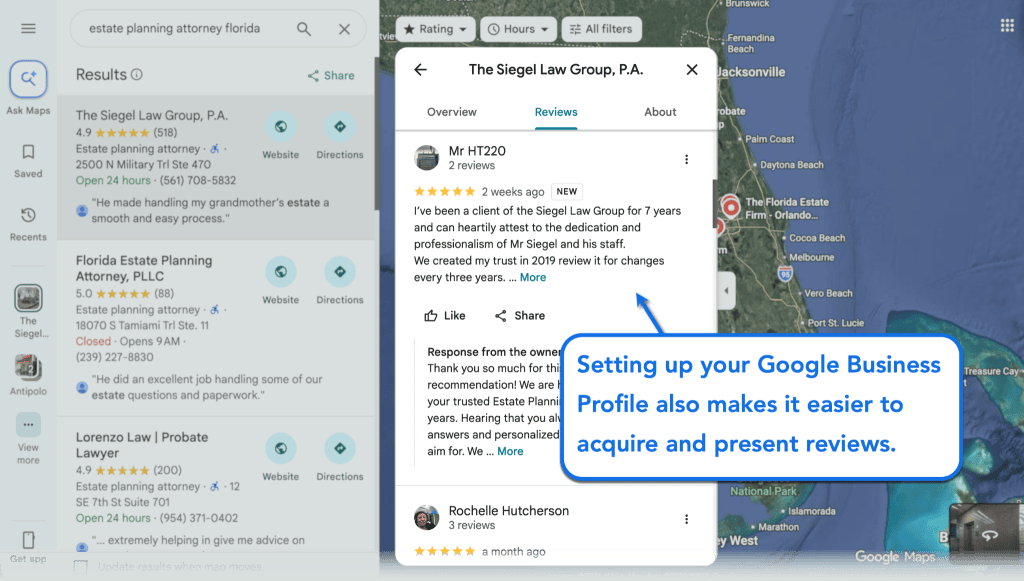
Google Business Profile also comes with tools to help you amass and showcase reviews. Not only does it make it easier and more convenient for clients to write reviews, their feedback and ratings will also automatically appear in search results and Google Maps.
To strengthen your local SEO results, it’s also important to build citations in law firm directories. This includes:
- FindLaw
- Justia
- Avvo
- Nolo
- Lawyers.com
Don’t forget citation sources in your specific location, like your state bar association and local business directories.
Of course, there’s also the content optimization side of local SEO, which starts with the right set of target keywords.
This takes us to the next step…
2. High-Intent Keyword Mapping
Your target keywords list determines whether your SEO results translate to revenue or just website visitors who don’t convert into paying clients.
For starters, you don’t want to rank just for random legal terms, even if they get thousands of monthly visitors.
You want specific search phrases that align with your exact services and represent a high level of transactional intent. Look for long-tail, specific search terms that people use when they’re ready to hire (e.g., “best estate planning lawyer near me” or “trust attorney Orange County”).
An SEO tool with keyword research features, like Semrush and Ahrefs, will help you with this.
Just start with a seed keyword (i.e., “estate planning lawyer”), attach your location, and take a look at the results.
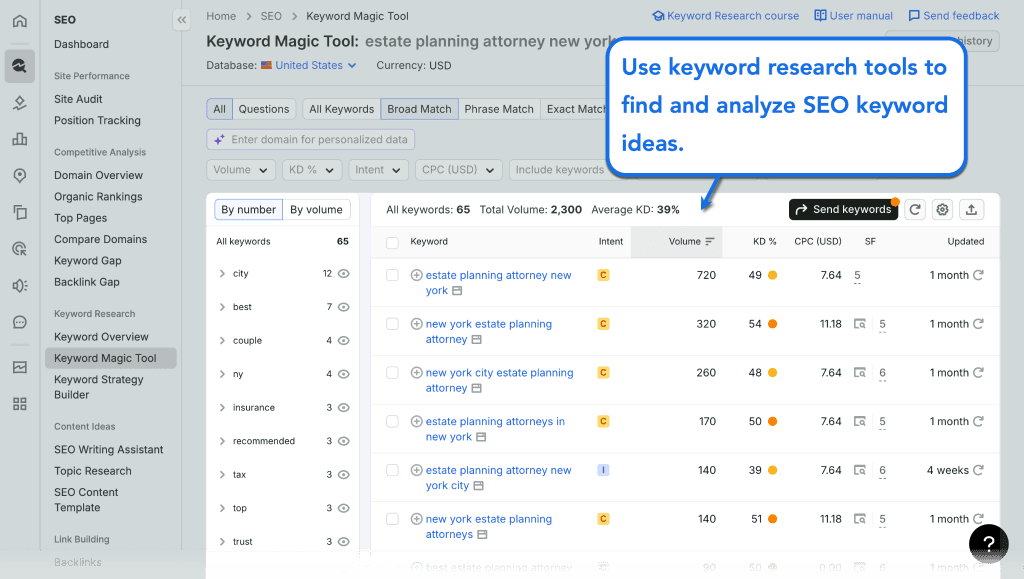
Remember the following when building your target SEO keywords list:
- Look at the intent column. Modern keyword research tools can easily identify keyword intent, be it informational, navigational, commercial, or transactional. Both commercial and transactional keywords are effective in pulling in traffic that’s more likely to convert.
- Don’t ignore keyword difficulty. High-difficulty keywords mean they’re already saturated with big-name competitors, making it exceedingly difficult to rank for them from scratch. Instead, go for keywords with low-medium competitiveness (0-49 for Semrush).
- Expand your keyword pool by looking at similar results. Use filters like “Related”, “Broad Match,” and “Questions” to find more specific keyword variations. In addition to expanding your keyword pool, similar keywords also work as substitutes for broader, highly competitive keyword opportunities.
Great, you now understand how to build an SEO keyword strategy.
Now what?
In general SEO, websites can be optimized for keywords by publishing relevant pages and blog posts.
You need to insert target keywords in important elements, like your content title tags, introduction, and URL slug (extension on your website’s address, like “mysite.com/blog/estate-planning-lawyer-nyc”).
More importantly, you need to build your website content strategy around these keywords.
3. Building SEO Content Silos
In SEO, a content silo is basically a group of related pages connected to a singular “pillar” page.
Think of it as a way to neatly organize your blog posts according to a parent topic. Instead of just publishing articles randomly on your website, you put them into specific buckets where users and search engine crawlers can easily find and associate with a core topic.
A graphic or diagram showing a silo structure
For example, as an estate planning attorney, your silos or buckets can be “wills and trusts,” “probate,” “special needs planning,” and “asset protection.” Each of these topics warrant their own pillar page, which will be connected to individual pieces of content about relevant subtopics:
Wills and trusts
- How to choose between a living trust and a will?
- How often do you update your estate planning documents?
- How to name a legal guardian for minor children?
Probate
- How long does the probate process take?
- How to avoid probate court
- What are a surviving spouse’s rights?
Special needs planning
- Setting up a first-party vs third-party special needs trust
- A guide to protecting government benefit eligibility
- What is a letter of intent, and does your family need one?
Asset protection
- Can an irrevocable trust protect your home from nursing home costs?
- Asset protection strategies for local business owners and doctors
- How to safeguard family inheritance from a child’s potential divorce?
Of course, each pillar page and cluster post (about subtopics) need their own target keywords.
While their keywords should be related, make sure there are no exact overlaps to prevent keyword cannibalization. That is when two or more of your own pages compete for the same keywords.
Lastly, make sure you incorporate topic clusters in your overall content marketing strategy. Read our guide on content marketing for law firms for more SEO best practices.
4. Implementing On-Page Optimization and Technical SEO
On-page optimization ensures that search crawlers, not just human readers, can easily discover and understand what your content is all about.
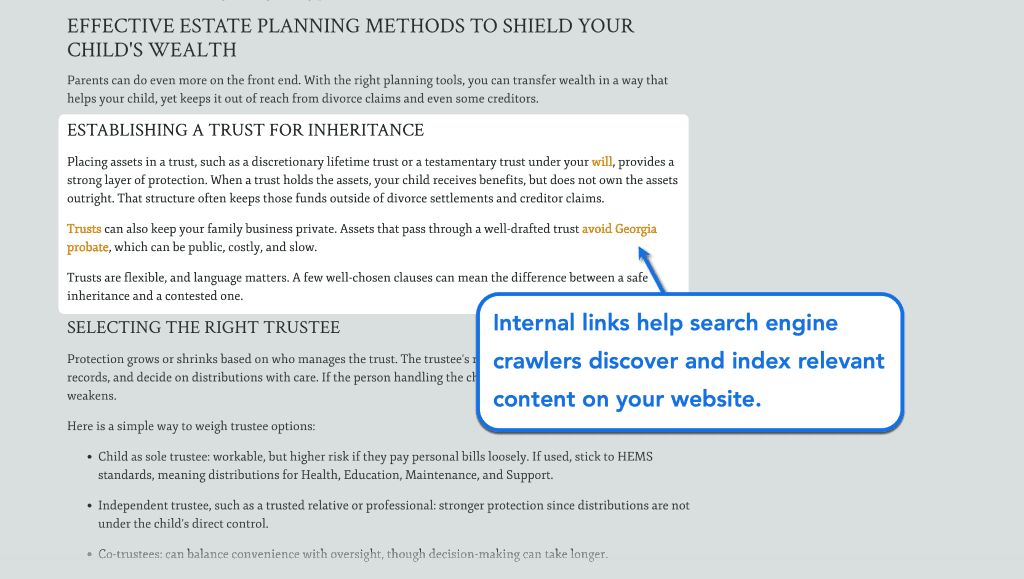
Start by making sure your topic clusters are connected together via internal links. This allows crawlers and users alike to discover more relevant posts.
It’s also important to optimize your website’s performance, which is a well-established ranking factor and an essential component of the user experience.
Use PageSpeed Insights to analyze your website’s performance, identify issues, and discover actionable recommendations for fixing them.
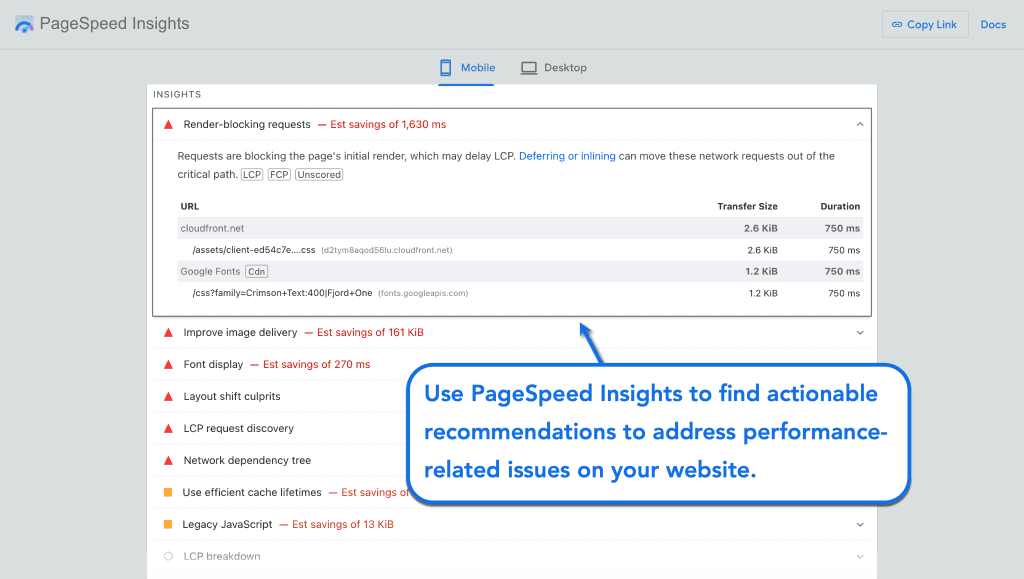
Adding internal links and analyzing your website’s performance are just two of the on-page optimization steps you can do on your own.
For a complete list of technical SEO issues on your website, consider using a site audit tool from platforms like Semrush.
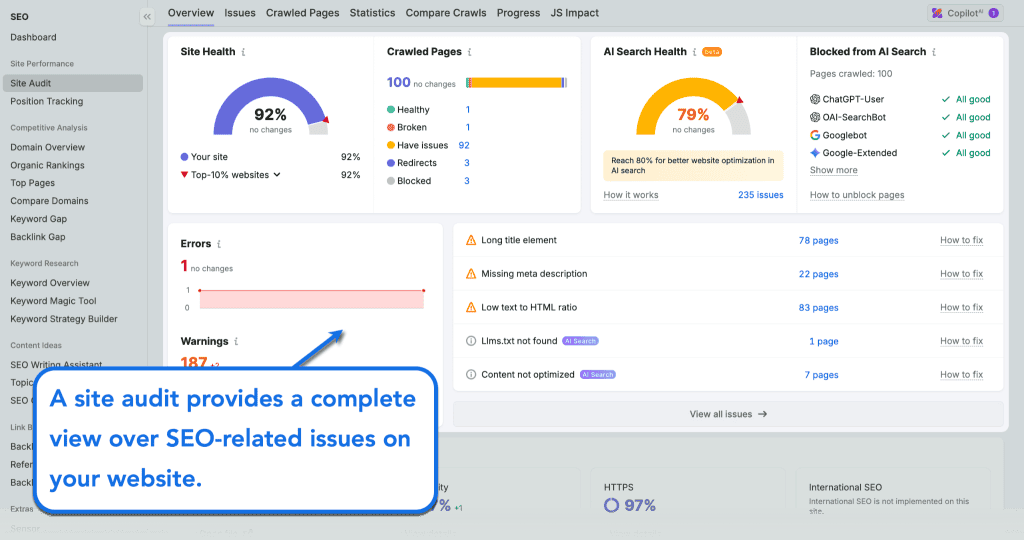
To help you create a step-by-step technical and on-page SEO roadmap, here’s a quick checklist for your reference:
- Elevate website performance by tracking Core Web Vitals (CWV): CWV metrics like First Input Delay (FID), Cumulative Layout Shift (CLS), and Largest Contentful Paint (LCP) help you understand how website performance translates to real-world user experience. Check the diagnostic report from PageSpeed Insights for actionable steps on improving these metrics.
- Optimize your title tags: A title tag is the first, clickable headline that people see in search results. Make sure it includes your primary keyword and target city or state to help crawlers and high-intent users understand what your page is about.
- Organize your heading structure: Use the H1 tag to highlight your main topic and multiple H2s to break down the subtopics. This improves your content’s scannability and topical authority, especially if you use keyword-optimized subheadings.
- Write short but clickworthy meta descriptions: In search results, the meta description is the short paragraph of text that appears directly below the title. Use custom meta descriptions that highlight your content’s keywords while emphasizing the value that readers can get from your page.
- Add a Frequently Asked Questions (FAQs) section: Whenever possible, add a quick list of FAQs at the bottom of each page. This helps you optimize your content for question-based keywords while also allowing your page to appear in “People also ask” rich snippets.
- Identify and leverage internal link opportunities: Before publishing content, do a top-to-bottom review to identify missed internal link opportunities. Keep them natural and relevant to the original topic while making sure you use descriptive, keyword-optimized anchor texts (avoid generic anchor texts like “click here”).
- Keep URL slugs short and simple: Remove random numbers, dates, symbols, and excessive words from your post or page URLs. Keep it short and keyword-focused.
- Address broken links: Remove or fix broken links (404) since they signal poor quality and maintenance standards to search engines. Broken links typically happen when the URL is updated for any reason or if the page itself is taken down.
- Utilize schema markups: Use schema markups (e.g., “LegalService,” “FAQPage,” and “Article” to show search engines the context behind the information on your website. Make sure to use the Schema validator tool to check if markups are implemented properly.
- General content quality issues: Site audit tools may flag content-related issues such as poor readability, bad heading hierarchy, and non-descriptive anchor texts for links. Each of these issues is a missed opportunity to enhance your website’s quality and ability to rank in the eyes of search engines.
5. Authority and E-E-A-T Building
With such high stakes, Google wants to make sure that estate planning advice comes from real, licensed attorneys who already have the Experience, Expertise, Authoritativeness, and Trustworthiness (E-E-A-T) in the industry.
In the digital world, you can prove E-E-A-T to search algorithms with the following strategies:
- Comprehensive and detailed attorney bios: Make sure your attorneys have their own robust profiles. Highlight their credentials, courtroom experience, certifications, associations, and other achievements.
- Link out to other authoritative sources: Include outbound links to authoritative websites, legal blogs, and reputable online directories. These links also add context on what your content is about, as well as provide value to your audience by showing them useful information.
- Showcase your actual media coverage: Feature logos and links to local news interviews, legal podcasts, and articles where your firm (or any of your attorneys) is featured.
- Transparent and consistent NAP details: Lastly, your website should include the exact same NAP information as your listings in online directories and your Google Business Profile. Make contact information easy to find to minimize friction in the client journey.
Nailing these trust signals shows Google that you are a legitimate, trustworthy authority in the estate planning space. It protects your traffic from sudden algorithm changes that deliberately target low-quality websites.
Top SEO and Content Tools for Estate Planning Firms
Part of the SEO learning process is getting to know the tools of the trade.
Here are the top, time-tested tools that will not only help you understand SEO but also execute your strategies effectively:
- Semrush: An all-in-one SEO suite for seeing exactly how competing law firms are getting their traffic online. Aside from advanced SEO analytics and optimization tools, Semrush also reveals AI optimization metrics, ensuring your firm also appears in AI-based conversations.
- Ahrefs: A pound-for-pound alternative to Semrush, focusing more on in-depth backlink analysis and technical SEO. Ahrefs makes it easy to find major gaps in your website optimization and content plan so you can pull ahead in search results.
- Google Search Console: A free tool that lets you track and optimize your website’s crawlability, underscoring opportunities to improve content discovery and indexation. It is a must-have tool for any business, complementing more robust SEO platforms like Semrush and Ahrefs.
- Google Analytics 4: Another free tool from Google, Google Analytics 4 provides a bird’s-eye view of your web traffic analytics. It identifies your top-performing pages, tracks your monthly traffic, and reveals useful audience demographics so you can adjust your strategy accordingly.
- BrightLocal: A local SEO platform designed to analyze your local visibility and ensure NAP data consistency. This can give your firm the advantage it needs to outperform competitors in your state or city.
- Whitespark: This straightforward, lightweight tool uncovers local directory opportunities. Getting your firm listed not only helps lead generation but also enhances your local map presence.
- Surfer SEO: A content optimization tool that will help your writing team maximize the rank-worthiness of their drafts. Surfer provides actionable and trackable recommendations in real-time, like a target word count, keywords to include, sections to cover, and more.
Maximizing Your Estate Planning SEO: What NOT to Do
Before you go, make sure to avoid these pitfalls to maximize your SEO results:
- Targeting overly broad keywords. Highly competitive keywords like “estate planning’ and “probate law” waste your budget and effort since they pit you against massively popular websites. These broad keywords are also used by people with informational intent, which means they’re only trying to learn and not hire a lawyer.
- Neglecting long-cycle user intent. Not all informational keywords are a waste, especially if they’re low-competition with decent search volume. These keywords (i.e., “what is the probate process”) let you build that connection with prospective clients early, keeping your firm top of mind when they’re finally ready to take action.
- Ignoring reviews: Every review is worth responding to, whether they’re positive or negative. In fact, answering negative reviews actually showcases your professionalism and desire to improve your services, proving to prospects that your client’s experience also matters to you.
- Publishing thin, generic content: It’s better not to publish blog articles at all than to flood your website with low-quality, AI-generated stuff. Make sure you prioritize content quality to establish your firm’s credibility and expertise, not just in the eyes of prospects but also of search engines.
Turn Local Search Visibility Into More Consultations
SEO success isn’t about churning out dry, generic legal articles and hoping for the best.
In the estate planning space, winning your prospective client’s trust is priority number one. This requires a real shift towards publishing high-authority content, building your digital footprint through directory listings, and ensuring you appear in local search results through your Google Business Profile.
Getting all these moving pieces up and running takes some real work.
The good news is, you don’t have to build and execute your strategy on your own.
If you want a full understanding of estate planning SEO and what strategies can get real results for your firm, we’re here to help.
Schedule a consultation with our team here at LaGrande Marketing, and let’s build an SEO campaign just for you.
Related Post
-

Spanish SEO For Lawyers: Why It Matters in 2026
Failing to target the rapidly growing Spanish-speaking demographic means you’re losing a lot of qualified cases to local competitors. Spanish speakers and bilingual audiences hold… -
DUI Lawyer SEO: Everything You Need to Know
Make no mistake: there are hundreds of potential DUI clients urgently looking for legal representation each day. So, if you’re struggling to get cases, it’s… -
The Ultimate SEO Guide for Criminal Defense Attorneys (2026)
As a criminal defense lawyer, you need every advantage you can get to boost your visibility, elevate your credibility, and acquire a steady stream of…