
How Much Should Your Law Firm Pay for Website Development in 2026?

A professional website is considered the digital extension of any law firm.
It establishes you as a trustworthy legal expert as well as provides reassurance to self-learning prospects who like to do their own research.
In this post, we’ll discuss the costs of creating a law firm website and how to create a budget that works for you.
Let’s get to it.
Why You Need a Law Firm Website?
Here’s a quick rundown of the benefits of having a professionally-designed website for your law firm:
- Unlock lead capture opportunities: A website lets you build landing pages, promote your legal services, and make it easier for potential clients to contact you. It is up 24/7, educating prospects and taking in leads through systems like scheduling tools and contact forms.
- Establish your legal expertise: Publishing informative, helpful articles that address your target audience’s questions is a time-tested way to build authority. Remember, in a high-stakes industry like the legal space, you need to win your audience’s trust before you convert them into leads and eventually paying clients.
- Support modern online research behaviors: Most website development solutions are designed with mobile-friendliness in mind, catering to modern users who prefer browsing the internet through their phones. Website content can also be optimized for AI answer engines, which expedites brand discovery, learning, and decision-making.
- Build visibility through organic Search Engine Optimization (SEO): The goal of SEO for law firms is to passively generate traffic from online search results, particularly for relevant keywords like “Long Island dog bite lawyer” or “personal injury attorney near me.” A website is a crucial prerequisite for building searchability while assisting leads through their hiring journey.
- Automate lead nurturing: Website content can be structured to provide a natural and seamless self-learning experience for potential leads. You can also implement tactics like newsletter marketing to automate and accelerate your lead nurturing efforts.
Despite all the upsides of owning a website, not every attorney sees it as a priority.
Solo practitioners, in particular, are more reluctant to invest in a professional website than larger firms. And that’s perfectly understandable, given that the cost of website development services ranges from around $1,500 to upwards of $30,000.
This begs the question: How much should YOU invest in website development?
Factors to Consider When Planning Your Website Development Budget
Let’s start by breaking down the things to consider when budgeting for your law firm website:
Visual Design
Cost Impact: Around $500
The level of visual fidelity can have a substantial impact on your website’s cost.
This may include high-resolution background videos, attorney photos, and various branding elements (e.g., logo design, color scheme, and typography).
Of course, you can save a lot if you choose a template-based approach. Simple themes for WordPress can go for as little as $19 on marketplaces like ThemeForest. Some all-in-one website platforms, like Squarespace, on the other hand, provide free “designer” templates with every paid plan.
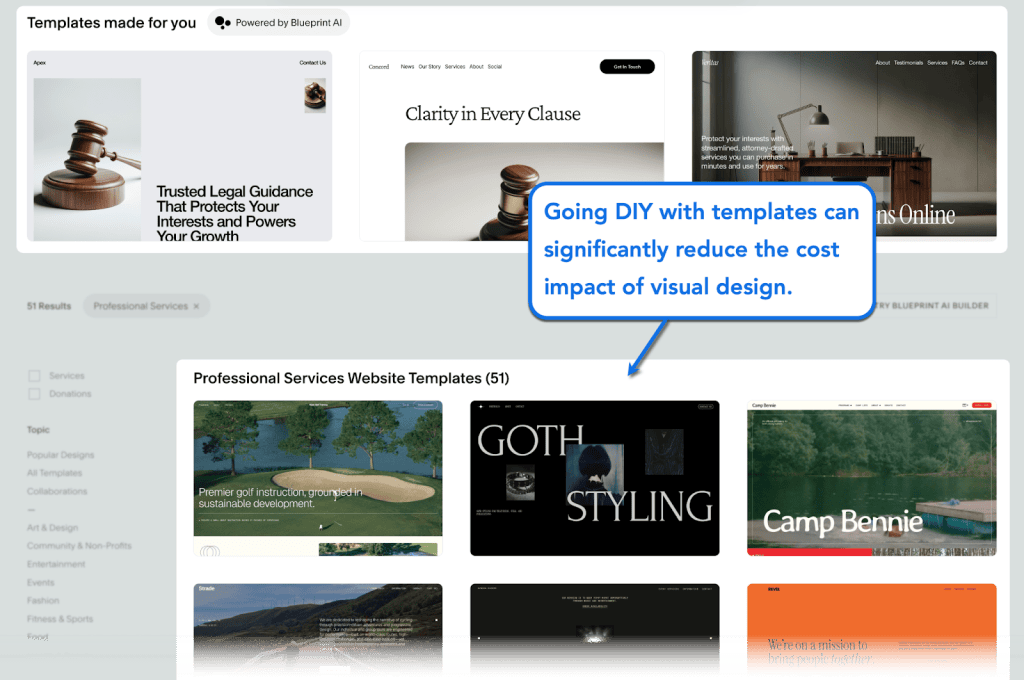
Take note that most website platforms also come with free themes and design tools. While these come with limited customizability, they’re a suitable option for cost-conscious lawyers who value raising brand awareness more than establishing an online identity.
Personalizing a template-based site, however, can be time-consuming if you take the DIY route. Alternatively, you can hire freelancers who specialize in your chosen website platform to instill your firm’s identity into your website.
Just don’t expect a cohesive, lean, and tailor-made website design built specifically for your branding goals. For example, we at LaGrande Marketing make sure that your page design and layout are built around the user experience. Every square inch of your website has a purpose, from capturing your audience’s gaze to encouraging interactions.
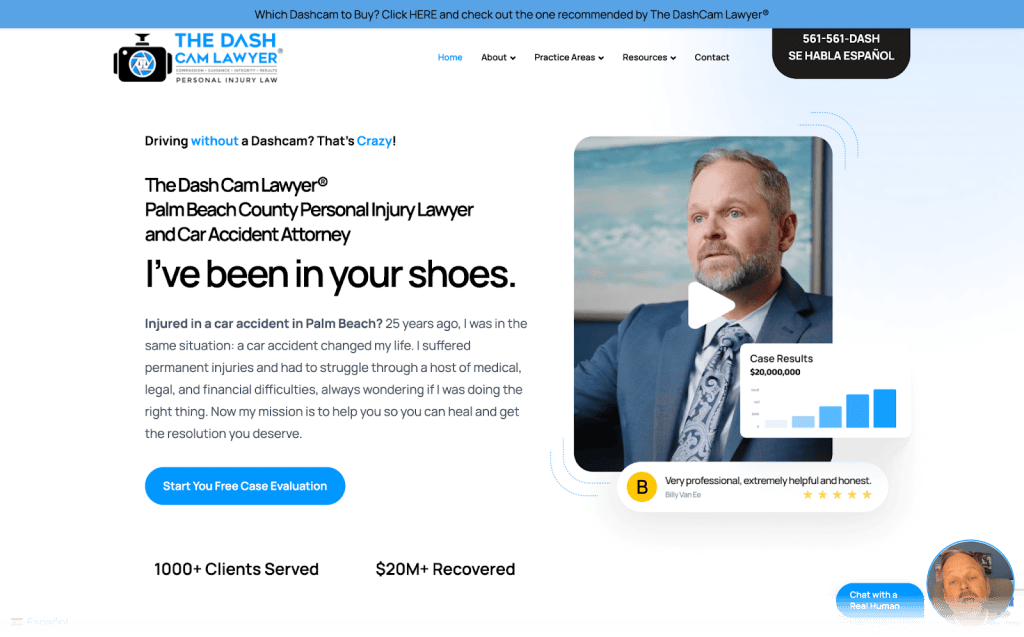
Keep in mind that, even if you buy the cheapest available theme or template for your website platform, you realistically still need around $500 (and up) for the initial setup and customization. That is, unless you plan to do everything yourself, which may take several days even for experienced website developers.
Functionality
Cost Impact: From $10 per month to $100,000+
Of course, the appearance of a website is just part of the user experience.
You should also pay attention to features that will make your website actually useful. This includes interactive booking calendars, contact forms, live chat, and client portals that provide a meaningful experience to your website visitors.
For solo lawyers, a practical approach is to piece your website together using plugins and tools that integrate the exact features you need. The more features you need (and the more advanced they are), the bigger your website development budget.
Larger firms may also commission the development of custom website systems (i.e., branded client portals), which may be API-based or created from scratch. Bespoke web-based software, however, may cost anywhere from $5,000 to over $100,000, which is out of reach for most small law firms and solo practitioners.
Content
Cost Impact: From $100 to $300 per page
Content, be it blog articles or explainer videos, is the main meat of any law firm website. Not only will high-quality content enable you to gain SEO rankings, it also gives you the opportunity to showcase your expertise and nurture clients into a hiring decision.
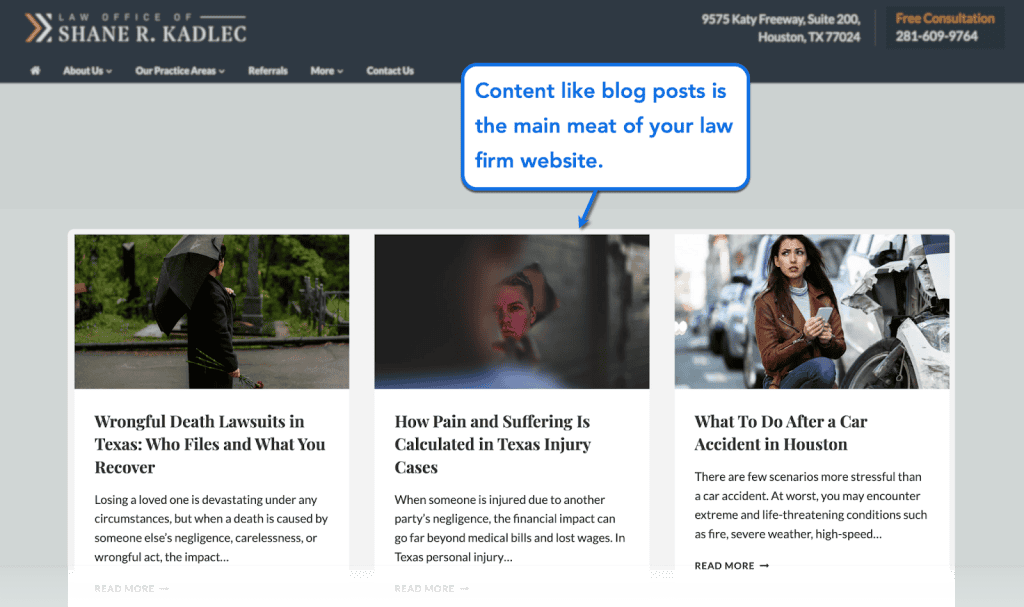
Although content creation isn’t the most expensive part of website development, it requires an ongoing investment and commitment. It also typically takes months before you start seeing measurable results from your content marketing efforts.
In terms of costs, law firms generally spend around $100 per page. This can be much higher for visual content, like professional photographs, videos, and infographics.
Due to the demanding nature of planning and executing a content strategy, most law firms only focus on foundational content at the beginning, including their “About” page, contact page, and landing pages for their core legal services. Post-launch, they can start exploring strategies like creating keyword-optimized content for SEO and hiring a video production agency.
Setup and Maintenance
Cost Impact: From $20 to $800 per year
Don’t forget to account for the essential services you need to get your law firm website up and running, mainly domain registration, web hosting, and basic encryption.
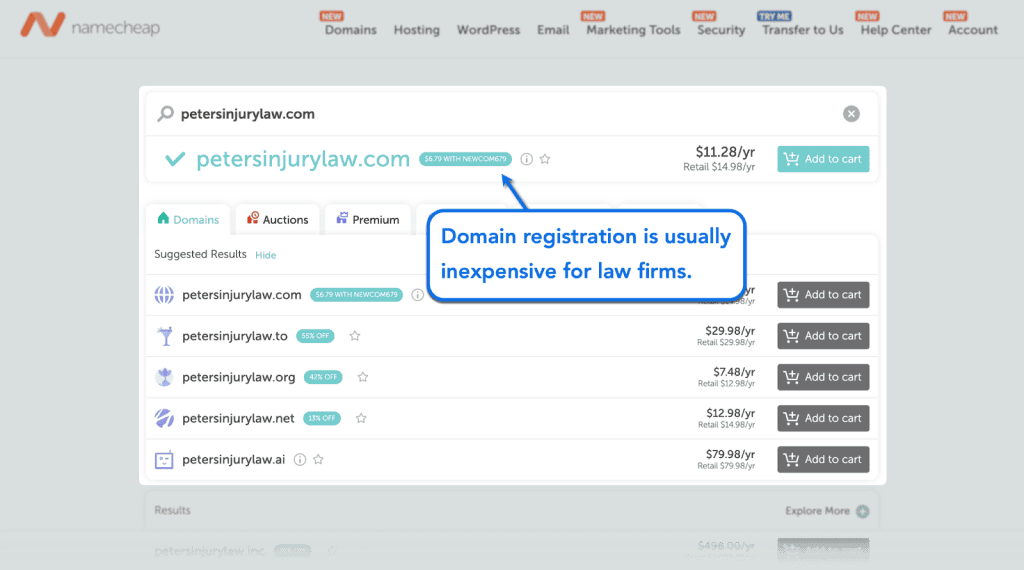
When it comes to your domain, it’s important to understand that the economy of domain names is widely unpredictable. But since law firm names are highly unique, it should be easy to find and register domain names for less than $20 per year.
Choosing your web hosting provider, on the other hand, could put a dent in your wallet or leave it virtually untouched. It depends on the kind of hosting plan and service provider you choose.
For example, a shared hosting plan can go for as low as $2 per month as an introductory rate, renewing to around $8 to $15 per month once your promo period expires. However, upgrading to a premium hosting plan with additional security features could run you up to over $500 per month.
The key here is to understand your website’s hosting requirements.
For small law firms and solo practitioners, an inexpensive shared hosting plan may be enough to provide your visitors with stable performance. On the other hand, larger firms with custom client portals, advanced security requirements, and high traffic volumes should consider more robust solutions like managed WordPress or even dedicated hosting.
Finally, every law firm website needs a Secure Sockets Layer (SSL) certificate, which authenticates your website and enables encryption. This is an essential security measure that protects your audience’s sensitive information and builds trust.
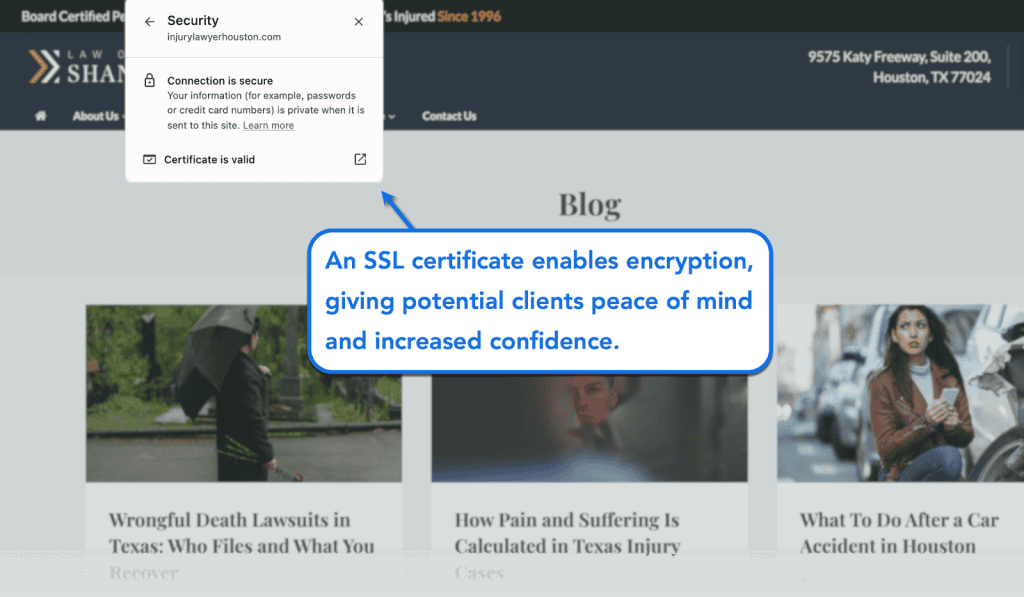
For an SSL certificate, small firms can temporarily use a free SSL certificate from services like Let’s Encrypt. But once it’s time to get a paid SSL certificate, it can cost you up to $300 per year.
Different Budget Tiers for Law Firm Website Development
At this point, you’re just about ready to create a budget plan for your law firm’s website.
To help with your decision-making, here’s a breakdown of five different budget tiers along with their pros and cons:
DIY/Starter Website ($0 to $1,000)
- Design: $0 to $50 for a professional theme
- Functionality: $0 using built-in tools for basic actions, like contact forms
- Content: $0 to $500 for foundational content
- Setup and Maintenance: $10 for hosting, $0 for SSL encryption
As the name suggests, the DIY approach to law firm website development maximizes savings in exchange for your direct involvement and commitment.
It also provides an opportunity to learn and sharpen your website design skills, as well as a handful of fundamental areas of digital marketing, like content creation.
The journey, however, is rarely a smooth one. And in most cases, DIY sites are a bit rough around the edges (but can definitely be improved over time).
Freelancer ($2,500 to $10,000)
- Design: $500 to $2,000 for premium theme or template adjustments and basic branding
- Functionality: $500 to $3,000 for functionality plugins like automated booking and contact forms
- Content: $500 to $2,000 for core pages and pillar posts for your main practice areas
- Setup and Maintenance: $200 to $1,000 for initial setup, $50 to $150 per month for recurring fees
In website development, a single freelancer can make a ton of difference in the finished product.
It’s where you start receiving expert advice on key aspects like design, content, and functionality integrations.
The main drawback, however, is the time it takes to achieve the results you want. With limited manpower, working with a freelancer could take several months to check everything off.
On the flip side, a seasoned freelancer can deliver the same results as a full-fledged web development agency. The only differences are the speed and agility in case something goes wrong or you decide to make adjustments.
Small Agency ($5,000 to $15,000)
- Design: $1,000 to $4,000 for a partly-customized theme with deeper emphasis on branding and user experience
- Functionality: $1,000 to $5,000 for third-party integrations and lead intake tools
- Content: $1,000 to $4,000, similar price per page to a freelancer, but usually has a wider scope (i.e., including keyword-optimized copywriting)
- Setup and Maintenance: $200 to $2,000 for initial setup, around $100 per month for ongoing maintenance and optimization
A small agency can deliver professional results within a substantially tighter timeline than working with freelancers. You can expect user-driven design, better overall content quality, and consistent publishing times.
Small web design agencies will also shoulder most of the responsibilities involved in building and optimizing a law firm website. This leaves you free to focus on your legal practice and other tasks like lead nurturing and advertising.
The downside is, a small agency charges more than individual freelancers. Not to mention that the scope of their services is narrower compared to that of a full-service agency.
Full-Service Agency ($10,000 to $25,000)
- Design: $3,000 for custom branding, uniquely-designed website theme, and conversion-focused user experience optimization
- Functionality: $3,000 to $10,000 for advanced tools and add-ons, like a personalized client portal
- Content: $2,000 to $6,000 for foundational content along with valuable add-ons like on-page optimization, professional attorney portraits, and video production
- Setup and Maintenance: $1,000 to $3,000 for the initial setup in addition to $200 to $500 in recurring monthly fees
A full-service agency does more than just web design. They also handle SEO, Pay Per Click (PPC) advertising, social media management, content marketing, and everything in between.
It only makes sense to work with a full-service agency if you have the budget and you’re looking to engage their bundled digital marketing services.
You’re not looking to hire them and stop once your website goes live. Rather, you’re looking for a long-term partnership, giving you access to their resources to grow your law firm’s website.
Once you set up your account with them, you no longer need to look elsewhere for help with other aspects of digital marketing. This guarantees cohesiveness and consistency when it comes to your brand identity and messaging.
Boutique Custom Web Design Agency ($20,000+)
- Design: $5,000 to $15,000 for a fully bespoke design and user experience
- Functionality: $10,000+ for custom systems, including branded client portals and other web-based features
- Content: $2,000 to $10,000+, slightly similar to full-service agencies, but can creep higher for specialized content specifically created for custom layouts
- Setup and Maintenance: $2,000 to $5,000 initial for premium hosting and security, up to $800 per month for ongoing maintenance and optimization
A boutique web development service is for established law firms that require a highly-tailored online presence and brand image. They’re definitely worth considering if you have a sizeable budget and a website vision that can’t be achieved with regular solutions.
The glaring issue with bespoke agencies is, of course, the price.
In fact, it’s not unheard of for large law firms to invest over $100,000 for a fully custom website.
Just remember that websites built by agencies or even freelancers can outperform a bespoke site, especially if you funnel your attention into other aspects of your online presence (e.g., your social media pages, customer service, and content marketing).
Website Development Tips and FAQs for Law Firms
How long does it take to build or redesign a law firm website?
When starting from scratch, a law firm can have either website up and running within 4-9 weeks. Starter or DIY websites can get you to launch in a week, but this usually involves ongoing work for optimizations and design adjustments.
Does my law firm website need a blog?
Yes, a blog is a must-have if you want a solid SEO presence. Blog posts also generate user engagement and prove your expertise to potential clients, making them essential for converting leads deep in the middle of their self-learning journeys.
Which functionalities or features are non-negotiables in a law firm website?
At the very minimum, your law firm website needs a functional contact form to make it easier for visitors take action. Make sure you also build with mobile-friendliness in mind while incorporating strong Calls-to-Action (CTAs), like “call now” or “schedule your free consultation.”
Final Words
For most law firms, a website is a huge investment. It can be the turning point that will ignite your firm’s growth, or a “vanity” project that drives little to no business outcomes.
Set your budget accordingly and be prepared to dive into the world of online marketing. In which, having a website is only the first step.
If you’re looking for a web design agency you can trust, click here and let’s talk about your project.
We’ve helped numerous clients become prominent names in their respective legal industries. We know what it takes to build a website that stands out and succeeds in turning attention into conversions.
Related Post
-

9 Best Legal Directories for Lawyers and Law Firms
Not all online business directories are the same. If you want to increase your law firm’s online visibility and attract qualified prospects, you need to… -
How Law Firms Scale with The Right Tech Stack
Plenty of law firms don’t consider the big picture when it comes to digital transformation. The typical approach is to adopt one solution at a… -
How to Use Live Chat for Attorneys: The Ultimate Lead Conversion Guide
Modern legal consumers operate on a timeline of instant gratification. If an injured slip-and-fall victim or a stressed parent seeking a divorce lands on your…