The Ultimate Guide to Medical Malpractice Lawyer Marketing

Securing high-value medical malpractice cases requires a digital marketing strategy around early trust-building and precise audience targeting.
Unlike standard personal injury claims, prospective medical malpractice and professional negligence clients rarely start their search with a clear understanding of their legal options.
Most victims search for medical answers online long before they realize their doctor or health provider made a severe error. And to reach prospects early in their journey, your marketing should be able to identify early intent, prove medical authority, and be optimized to make the hiring decision as easy as possible.
Understanding How Medical Malpractice Clients Search
Capturing medical malpractice leads requires understanding how they search for legal help online.
Remember, most journeys start with medical confusion rather than a clear intent to sue their provider.
Here are a few patterns you should know:
- Symptom and outcome-first searches: Many prospects search symptoms, complications, or unexpected outcomes before using the term “medical malpractice attorney.”
- Questioning medical care: Searches transition into questions such as whether a doctor made a mistake or if an unexpected surgical outcome was normal.
- Outcome vs. negligence confusion: Prospects may not know the difference between a poor medical outcome and actionable legal negligence.
- Family member research: Family members often conduct initial research on behalf of an injured or incapacitated patient.
- Incident-specific search behavior: Search behavior changes depending on the incident, such as birth injury, delayed diagnosis, surgical error, or medication error.
Consider these patterns when shaping your keyword strategy across paid advertising and organic marketing efforts.
In Pay-Per-Click (PPC) campaigns, targeting specific transactional phrases keeps your budget from draining on generic health questions. For SEO, publishing clear educational guides around medical complications lets you connect with families right when they start looking for answers.
Building the Right Medical Malpractice Website Structure
Your website architecture must reflect how prospective clients navigate medical harm topics.
A well-organized site helps visitors quickly find relevant information while giving search engine crawlers clear signals about your core practice areas.
Organizing Service Pages by Malpractice Type and Medical Event
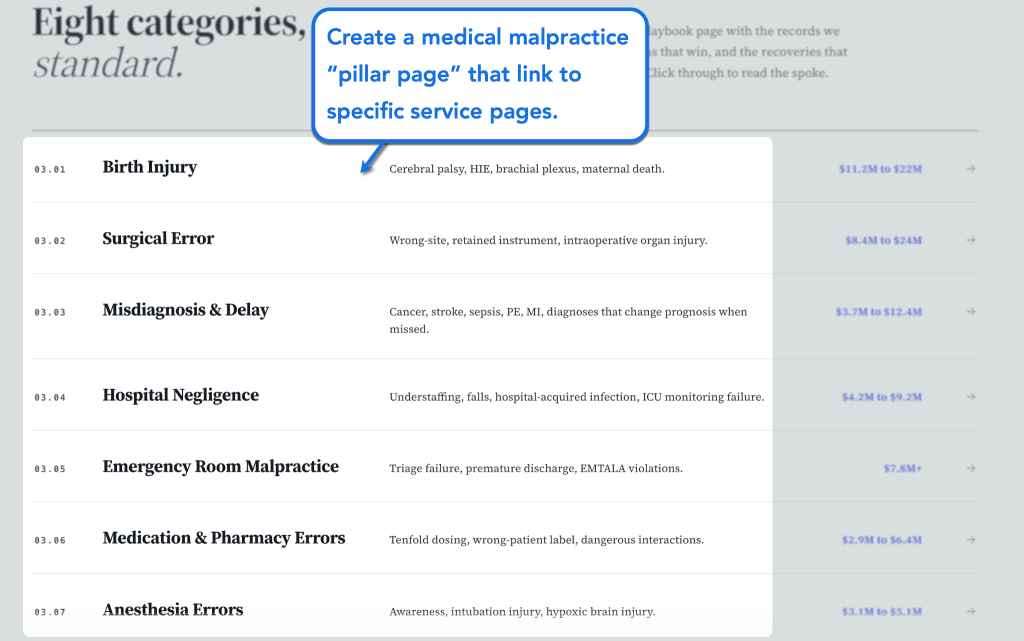
For starters, group your main service pages logically based on specific injuries, medical errors, and hospital environments.
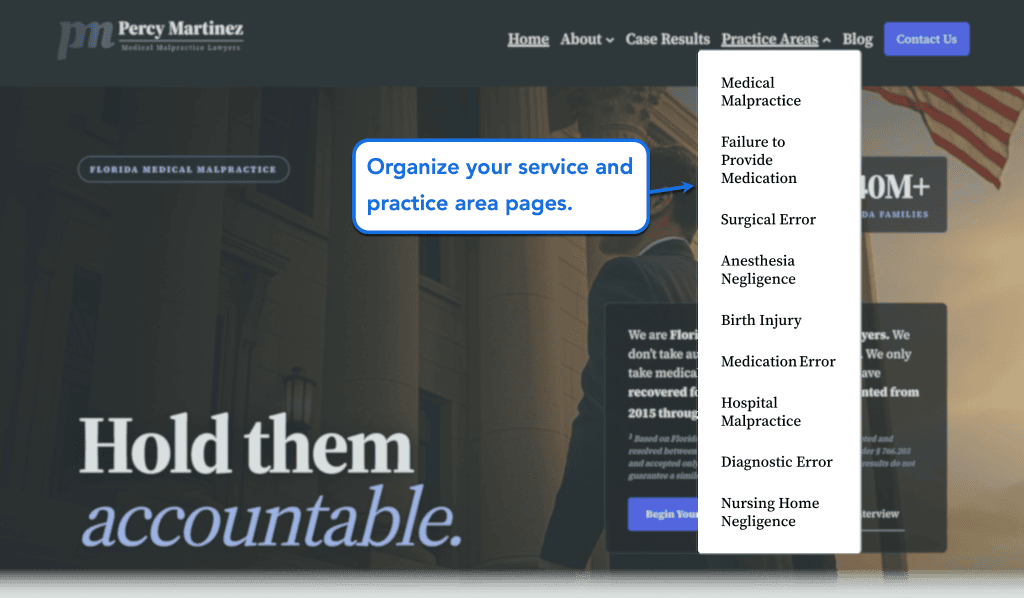
It’s also useful to create dedicated pages for core claim types. This includes failure to diagnose, surgical errors, medication errors, birth injuries, and emergency room errors.
Make these pages accessible from a single pillar page about medical malpractice in general.
Adding Supporting Condition and Injury Pages
Develop supporting pages focused on specific medical conditions and permanent injuries where they directly connect to potential malpractice claims.
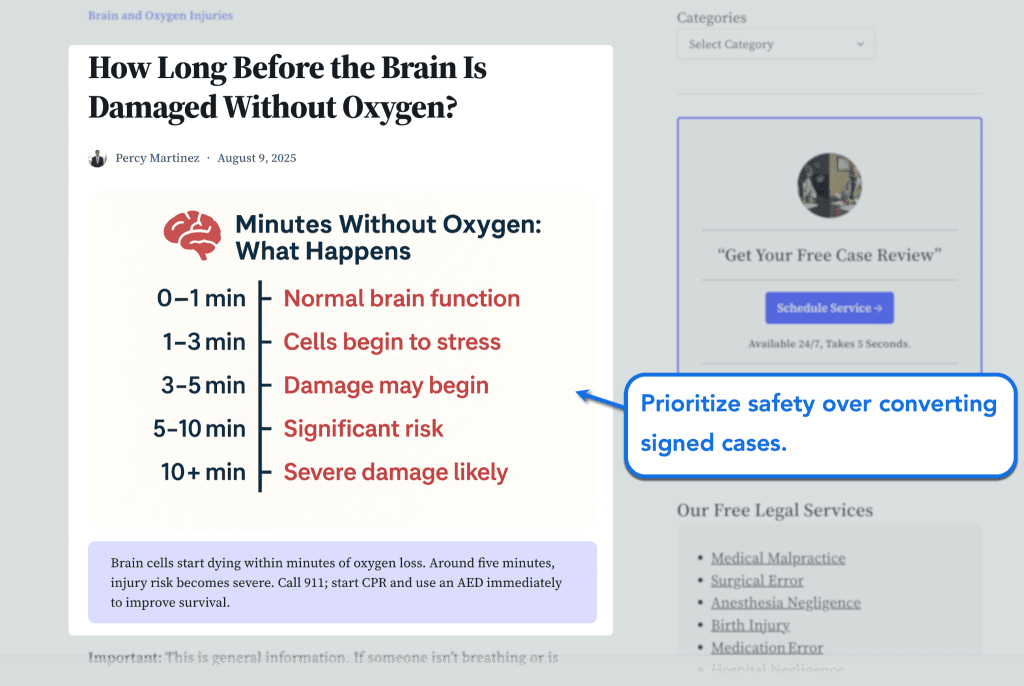
Remember, the goal of these pages is to open up prospects to the possibility of malpractice. But the content should also prioritize providing helpful information first.
Make the Case Review Process Easy to Understand
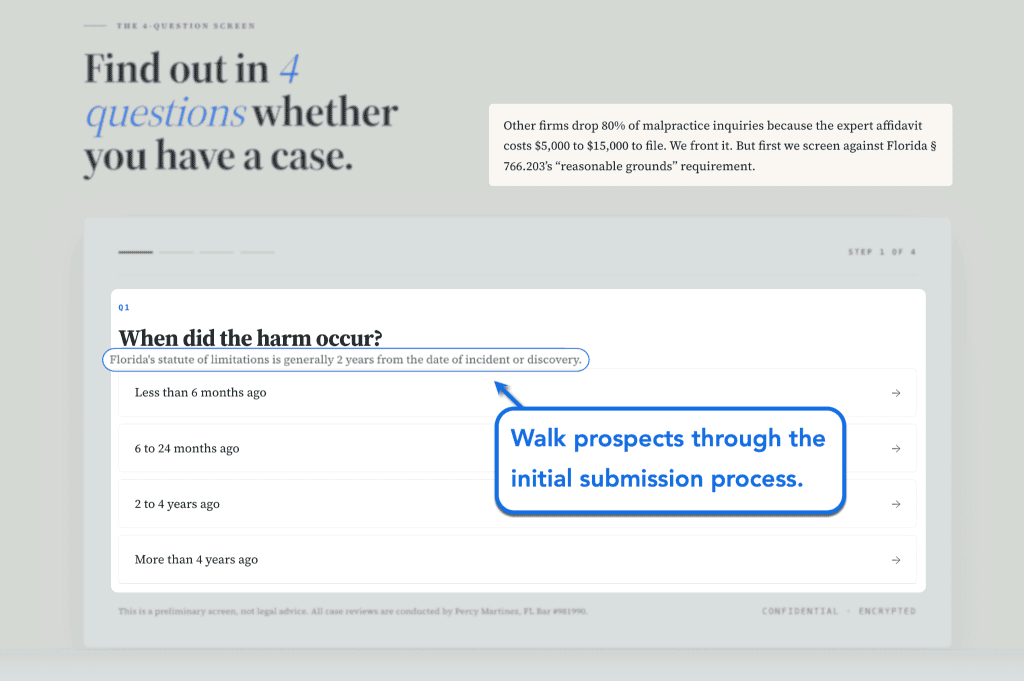
In medical malpractice, you’re catering to people under a lot of stress.
Clearly outline your firm’s case evaluation steps so visitors know what to expect when submitting their information. Better yet, walk prospects through the form submission process and explain why each detail is important.
Use Clear Site Navigation
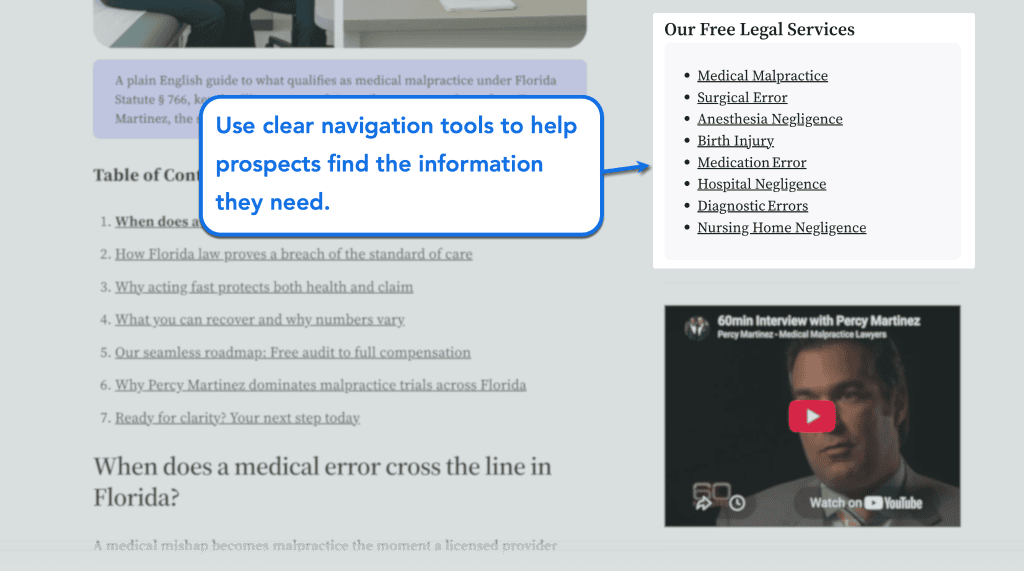
Finally, ensure seamless navigation between primary service pages, injury resources, geographic locations, and informational guides.
Don’t just rely on menus. Also implement sidebar navigation links, inline links, and footer links to make it easier for prospects to find the information they need.
Keyword and Content Strategy
Going for keywords like “malpractice lawyer” rarely pays off.
Not only are longer, more specific keywords or questions easier to rank for, they also help you land higher-quality prospects.
Longer keywords also provide more context on what searchers actually want, like “birth injury attorney in Lakeland.” This allows you to tailor your page to their specific situation.
Catching Prospects Early in the Process
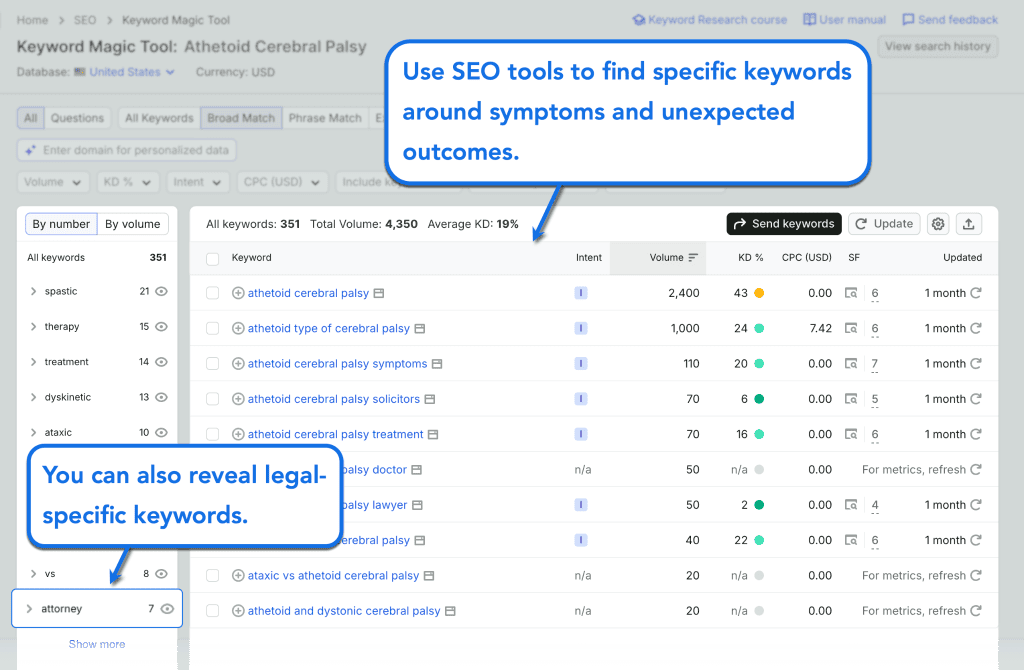
When a procedure goes sideways, people research symptoms and recovery timelines long before searching for a firm.
Setting up pages that target these specific health complications lets you connect with injured patients right as they start piecing together what went wrong. Think of searches based on symptoms, medical errors, and unexpected outcomes.
But rather than providing broad medical advice, your content should also explore how these complications tie in with possible negligence. Guide them through the legal questions they should ask and when it’s time to contact an attorney.
You can use SEO tools like Semrush to reveal specific keywords tied to these topics. You may also filter keywords by intent (commercial and transactional) or question-based modifiers, which which may indicate stronger intent to contact a law firm.
Targeting High-Intent Keywords
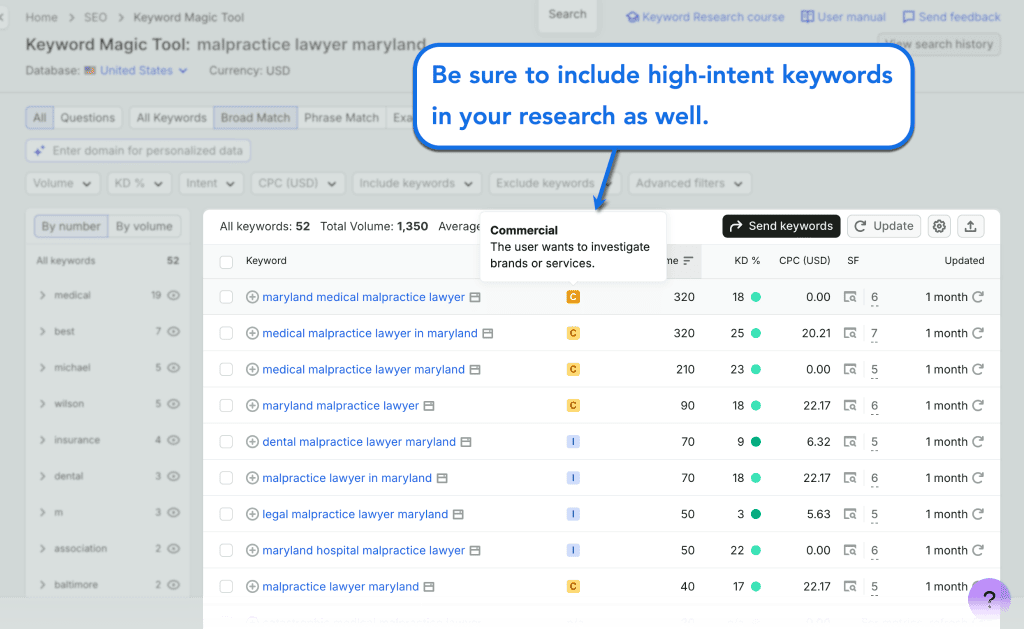
Remember, you also need to target commercial and transactional keywords to pull in prospects near their hiring decision.
On top of keywords designed to capture prospects early, also research keywords with high-intent medical queries, like “birth injury lawyer.” These keywords can be narrowed down further by adding your location, like “birth injury lawyer in Maryland” or “surgical error attorney in Baltimore.”
Once you find the right keywords, the next step is to integrate them into your website content strategy.
Building Your Content Strategy
Similar to your service pages, make sure your website content pieces are organized under clear categories and interlinked via a pillar page.
Some of your articles, for example, may fall under the “birth injury” parent topic, whereas others could be under “medical error.” Just try to avoid wasting resources on broad health topics unless you can form the connection to medical malpractice, legal rights, or your firm’s other legal services.
Just be sure your content strategy tackles the legal realities of medical malpractice claims, such as:
- Claim viability: Inform prospects about the differences between unavoidable, poor medical outcomes and avoidable professional negligence.
- Statutory requirements: Explain the state-specific malpractice laws, statutes of limitations, and notice periods.
- Evidence and expert review: Share details on the evidence needed to build a case, like witness statements, independent medical expert reviews, and medical records.
- Damages and compensation: Explain how medical bills, lost wages, future care costs, and pain and suffering can be analyzed and what usually goes in the final amount.
As you build your content, extend their reach by pushing them on social media, email marketing, and referral-partner channels.
Maximize your content investment by repurposing your articles into video scripts, social media posts, newsletters, and other short-form content formats across multiple channels. You can then tap into social media publishing strategies and tools to increase content visibility and reach relevant audiences across additional channels.
Establishing Trust in Medical Malpractice Content
Families dealing with medical negligence are understandably anxious and distrustful.
They need direct answers and quick proof that your firm can handle complex litigation and deliver results.
Here are ways to accomplish this through your content:
- Showcase results without the hype: Highlight real case experience to build credibility faster than generic marketing copy. Detail past settlements and trial verdicts; just keep the tone grounded and never promise specific or similar financial outcomes.
- Transparent authorship and credentials: Clear authorship and credentials help readers assess the reliability of the content and strengthen trust signals. That said, add an informative author box with credentials and a link to the full attorney bio under each post.
- Avoid medical jargon: The last thing your potential clients need is overly technical medical terminology. Break down complicated surgeries, doctor errors, and clinical terms into plain language.
- Cite sources and real scenarios: Back up claims by citing medical journals, state codes, and official hospital standards. Use anonymized, real-world case stories to give prospects an idea of what to expect.
- Vet for factual accuracy: Always run content past a staff attorney or medical consultant before pushing it live on your website. Accurate information protects your firm’s reputation and prevents anxious readers from acting on bad advice.
Turning Website Visitors Into Case Reviews
Getting website visitors doesn’t matter much if you don’t convert them into leads and, eventually, signed cases.
The goal is to make it easy for qualified visitors to understand their options and request a case review. This is possible through:
1. Short and Simple Contact Forms
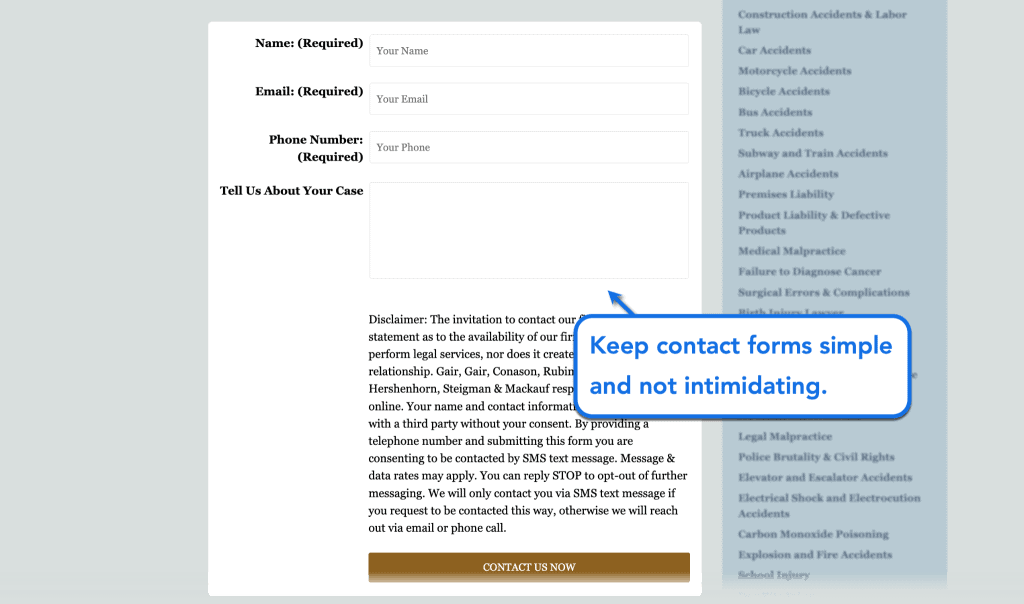
Avoid using contact forms with dozens of mandatory form fields. Eliminate as much friction as possible by only asking for the information you need to get a conversation going.
At most, ask for a short sentence to explain what happened. Just be sure to use visible Call-To-Action (CTA) buttons with clear hooks, like “Request a Case Review” or “Contact Us Today.”
2. Show Multiple Ways to Get in Touch
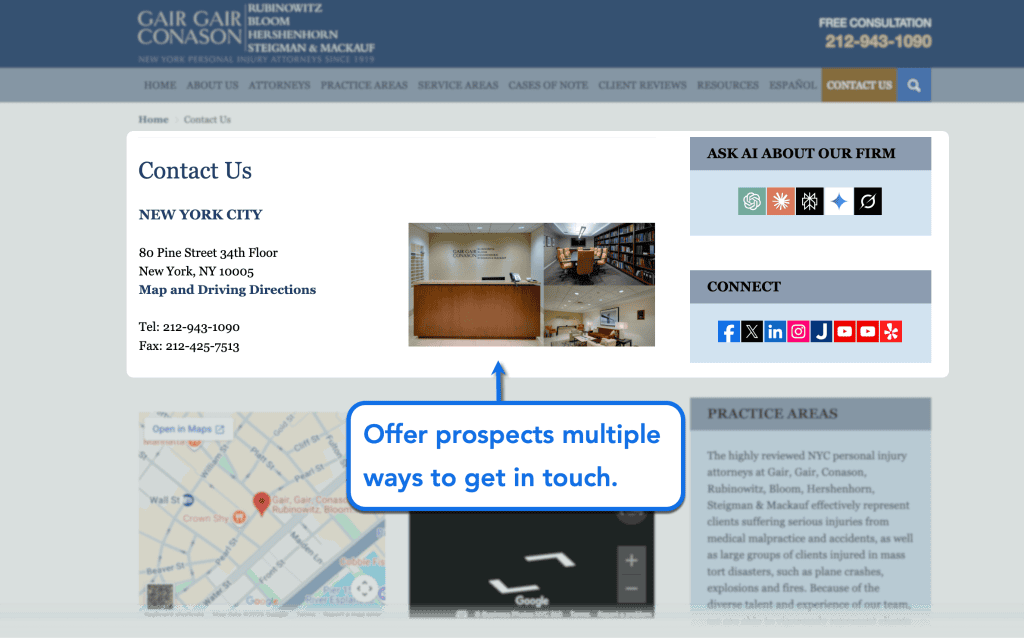
Apart from your contact form, make sure your phone number and chat boxes are impossible to miss.
A typical strategy is to put click-to-call buttons right at the top of your website’s banner. This is a huge convenience to prospects who need answers right away.
3. Reassure Worried Readers
Some people hesitate calling a law firm because they worry about paying for unexpected bills or getting trapped in a long, drawn-out legal process.
That’s why you should emphasize how little risk is involved should they decide to reach out. Mention outright that case reviews are free and confidential, with no obligation to hire the firm.
Just remember to explain that submitting an inquiry doesn’t automatically create an attorney-client relationship. This will reduce the stakes of reaching out to your firm, which can boost the confidence of some prospects.
4. Implement Mobile-First design
In medical malpractice, many prospective clients browse attorney websites from a hospital waiting room or on a smartphone at home.
Be sure to plan your website’s layout with smaller mobile screens top of mind. Test your contact forms on actual phones so visitors don’t have to deal with broken or invisible buttons and clunky formatting.
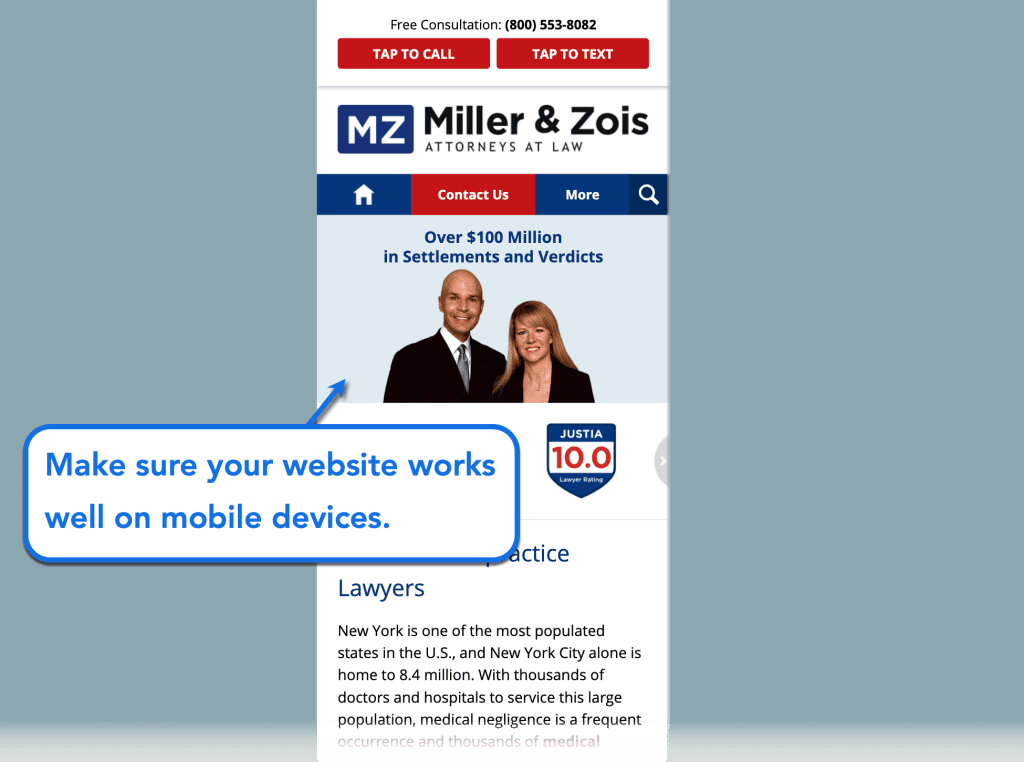
Tip: Consider using free mobile-friendliness evaluation tools like Google Lighthouse.
5. Add Trust Signals Near Forms and Actionable Elements
Place quotes, reviews, trial results, and other positive stats right next to intake forms. These are essential trust-building elements that push hesitant visitors into taking action.
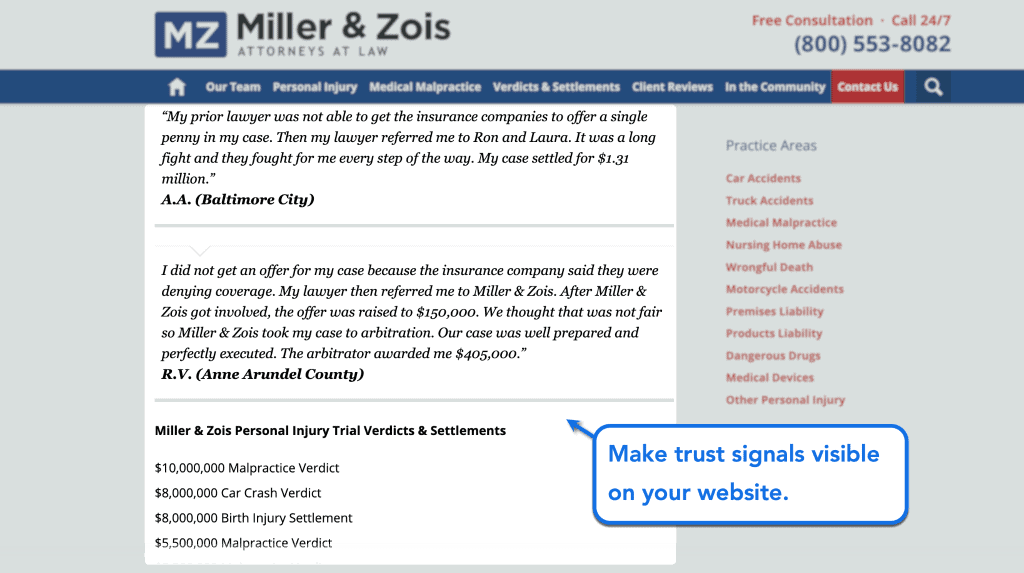
Remember to avoid implying that every case you take on will achieve the same result. This may violate state attorney advertising rules, many of which are based on American Bar Association (ABA) Rule 7.1.
Medical Malpractice Intake and Lead Qualification
Although organic traffic growth depends on competition, authority, and ongoing investment, the strategies abov will get the ball rolling.
This is the ideal time to refine your intake pipeline:
- Initial case screening: Train your intake team to gather important treatment dates, medical provider names, specific injuries, and financial damages on the very first call. Missing a statute of limitations or misjudging injury severity early on wastes valuable firm resources down the road.
- Evaluating review viability: Not every poor medical outcome stems from negligence. Intake staff must be trained to determine if the documented facts actually justify sending records out for formal attorney and physician expert review.
- Staff training and escalations: Train your front-line intake team to recognize key liability signals during the initial call. Whenever a case seems unclear, immediately route it to a senior lawyer so potentially viable matters receive prompt attorney review.
- Tracking rejections, referrals, and acceptance reasons: Keep a detailed record of all lead outcomes from every incoming inquiry. Analyze these patterns to refine your targeting and lead qualification workflows, helping you spend less on unqualified leads.
- Automating follow-up workflows: Most prospects tend to stall before giving you complete medical and treatment timelines. Build automation workflows with your email marketing or CRM platform to send email and text follow-ups targeted at hesitant prospects after they finish their intake forms.
PPC for Medical Malpractice Cases
Organic marketing strategies for law firms, regardless of practice area, take time to get significant results.
To gain quick traction, invest in paid advertising strategies to begin generating targeted traffic and inquiries sooner than organic channels typically allow.
For search advertising, there are two routes you can take: running Google Ads or Local Services Ads (LSAs).
Google Ads utilizes a PPC cost structure, which charges you for every click your ad gets. LSAs, on the other hand, use a Pay-Per-Lead (PPL) model, which only charges you for each lead your ad actually generates.
Either way, both campaign types can provide prominent paid visibility above or alongside organic search results.
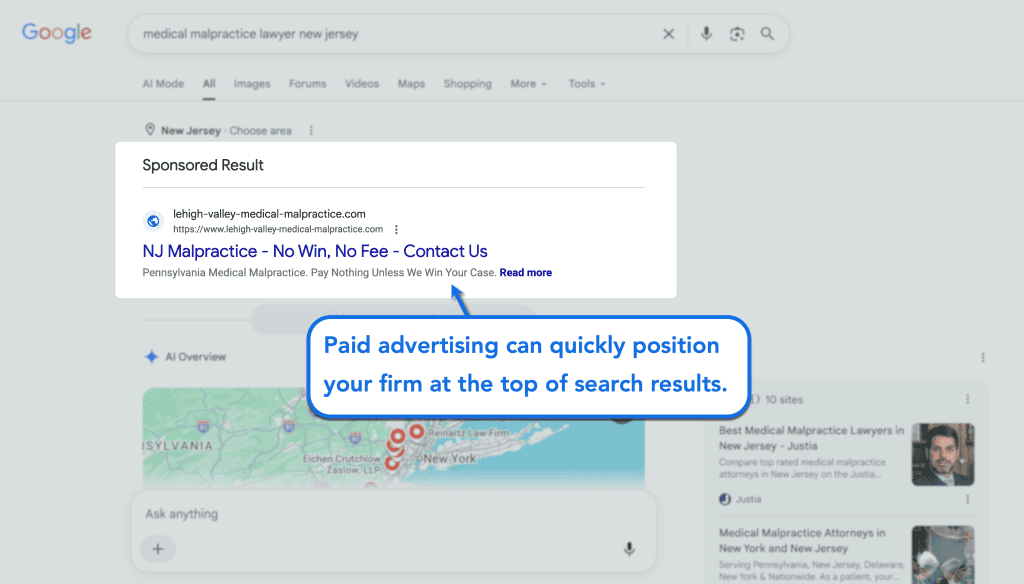
What’s The Difference Between Google Ads and LSAs?
An LSA campaign may seem like the obvious choice. Apart from the more appealing PPL cost structure, LSAs also come with a “Google Verified” badge, which is huge for building trust.
However, setting up an LSA campaign also involves more intensive screening, with numerous verifications like bar license validations, identity checks, and business details cross-references.
And while Google Ads may look inefficient due to the PPC structure, campaign performance can be significantly improved through more rigorous audience targeting and optimization practices:
- Campaign structure and focused landing pages: Organize your campaigns around specific claim types (e.g., birth injuries, missed diagnoses, and surgical errors) as opposed to launching a broad-targeted campaign. And rather than taking traffic to your homepage, build specifically designed landing pages tailored to a specific audience.
- Keyword match types and negative filters: Ensure your ads only reach the right-intent audience by focusing on exact and phrase match keywords, while monitoring conversion data to control relevance. Also use negative keyword filters to block users seeking medical advice, another specific law firm, symptom checklists, or other unrelated topics.
- Track real case returns: Don’t rely on raw form fills or phone calls when analyzing campaign performance. Instead, connect your intake software to your ad platform accounts to identify which campaigns and keyword sets actually resulted in signed contracts.
- Import offline data to ad networks: Send data about signed clients back into your ad platform. This helps ad platforms and algorithms optimize toward higher-value conversions by targeting similar users.
- Privacy rules and retargeting limits: Be sure your ad copy meets the ABA advertising rules and standards, respecting medical privacy laws and avoiding false outcome guarantees. When running retargeted campaigns, keep the ad copy slightly generalized rather than specifically addressing the specific injury, procedure, or condition they were browsing on your website.
Local Visibility for Medical Malpractice Firms
Another way to strengthen visibility in location-based searches is to invest in local SEO.
This targets placements on local search features, like the Local 3-Pack and Google Maps.
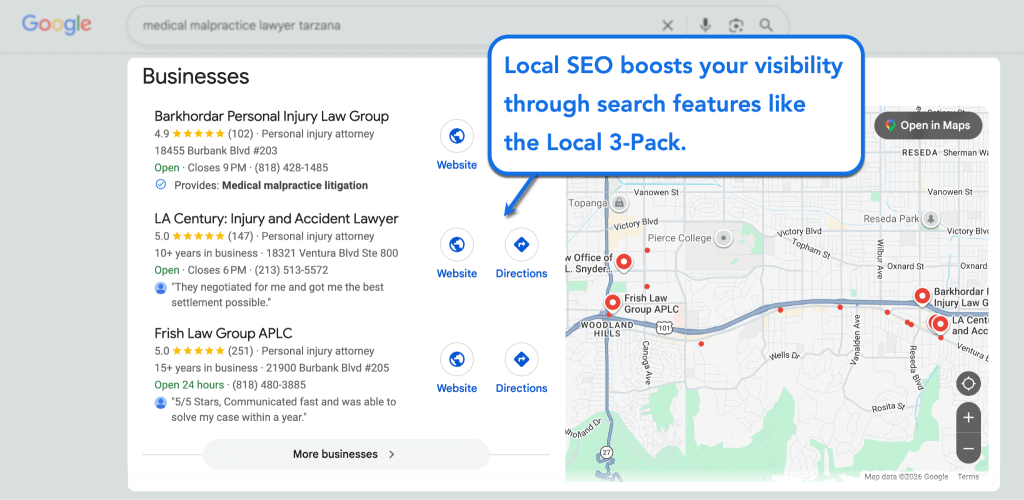
Here are the steps to build your firm’s local search visibility and authority:
Step 1: Start with Google Business Profile
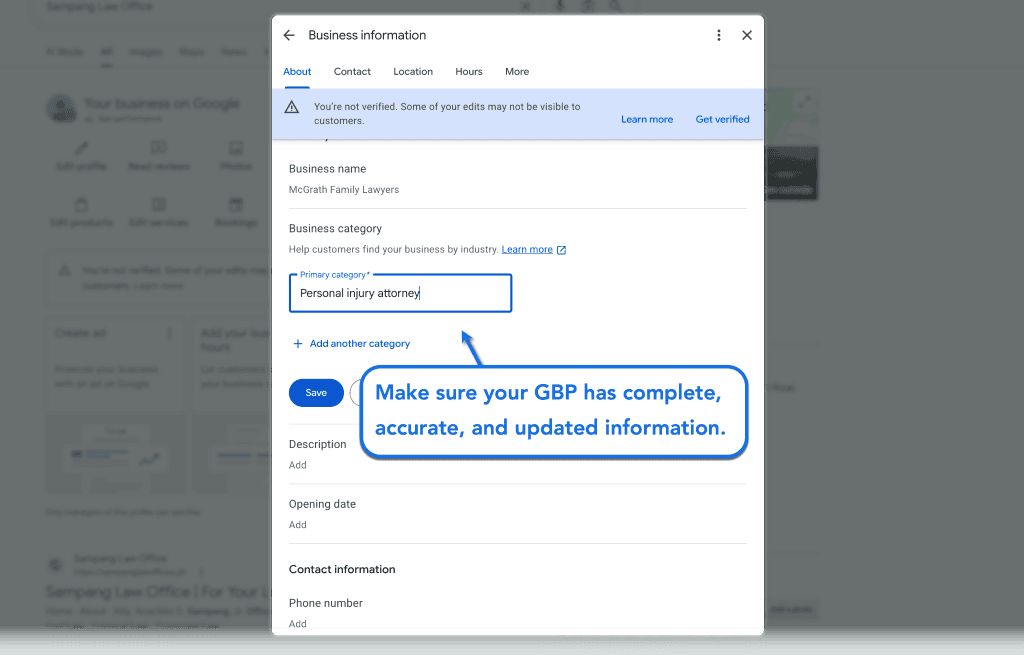
Optimize your Google Business Profile by:
- Picking “personal injury attorney” as the primary category, or something broader like “lawyer or “legal services” if your firm specializes in mixed practices.
- Using consistent Name, Address, and Phone (NAP) details with the information on your website.
- List the specific legal services you offer in detail.
- Upload photos of your team, office, events, front entrance (useful for directions), and other images that highlight your culture.
- Add posts that address your target audience’s pain points and concerns to answer common questions and keep the profile useful and current.
- Fill in every text field to ensure your GBP has complete, up-to-date information.
Step 2: Encourage Client Reviews
Encourage satisfied clients to leave positive (and honest) reviews about their experience with your firm.
This works as necessary social proof, which most clients look for before choosing to engage professional services.
Ideally, clients should publish their reviews directly on your Google Business Profile. This ensures their opinions and ratings are instantly visible to other prospects.
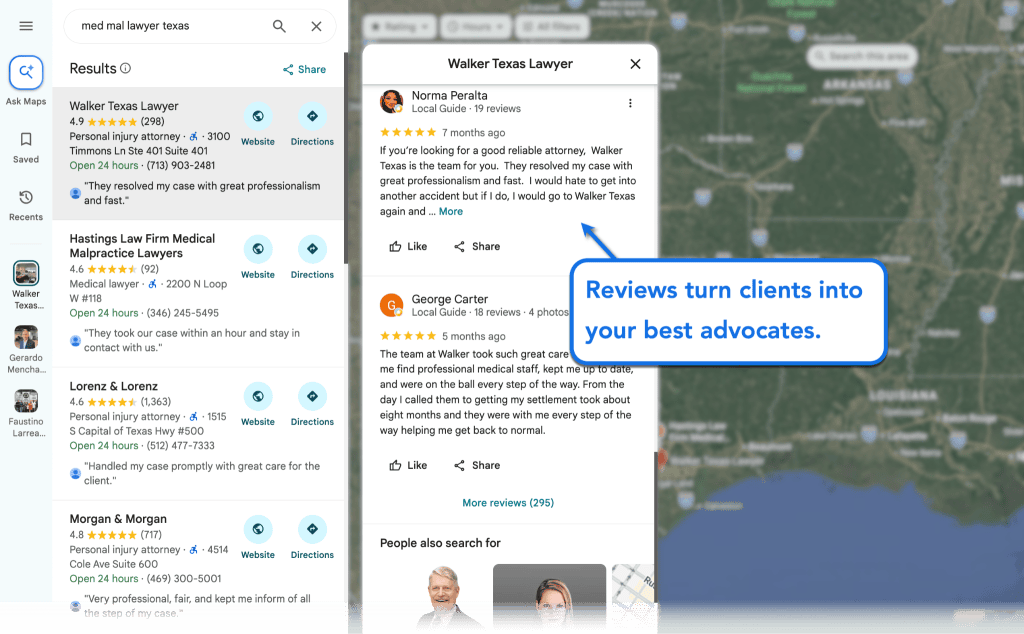
Just remember that, according to ABA model rules, reviews should be truthful and not motivated by any form of incentive. Instead of offering anything of value to encourage reviews, make the request personal, focus on the client experience, and emphasize how truthful feedback can help others find a trustworthy lawyer.
3. Build Local Presence Through Citations
Obtaining citations in legal directories and local, authoritative sources will not only generate referral traffic.
In the eyes of search engines, consistent listings support business-data accuracy, referral visibility, and local search presence.
Start with authoritative legal directories like:
- Avvo
- FindLaw
- Justia
- Nolo
- Lawyers.com
- LegalZoom Directory
You should also aim to earn or build links from your local bar association’s website, legal publications, community organizations, and regional media through targeted PR campaigns.
4. Craft Unique Regional Landing Pages
If you want to pull in clients from nearby locations, build detailed pages focused on those specific areas.
Avoid copy-pasting the exact content from your other city pages. Each version should be personalized and tailored to the local audience, not the same template with swapped-out city names.
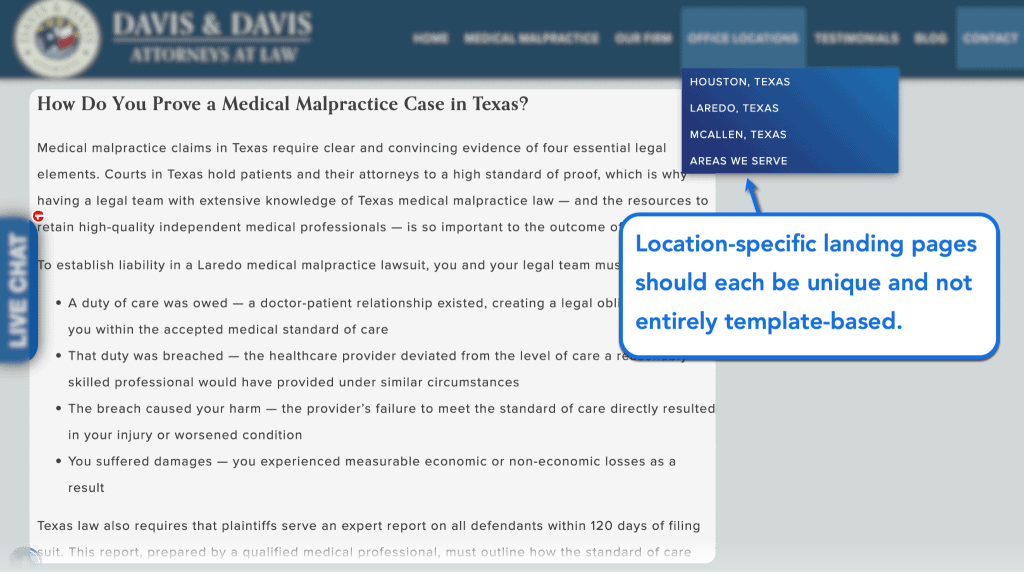
Provide real local value by highlighting regional court procedures. You can also share local medical resources and services that prospects residing in that area will find useful.
Building Referral Sources
Attorneys in different practice areas can become your best source of high-value cases.
In an attorney-to-attorney fee-sharing agreement, you send each other leads or work together as co-counsels.
- Spell out fee arrangements clearly: Put written, transparent fee-split agreements in place upfront so referring attorneys feel secure and respected.
- Streamline the intake handoff: Make transferring case files painless for referring firms by handling all record requests and initial client onboarding yourself.
- Showcase your trial record: For co-counsel opportunities, let local counsel know your firm actually has the courtroom experience and resources to fund expert review, discovery, and complex litigation.
- Send out quick educational emails: Send brief monthly notes highlighting recent state court decisions, case selection criteria, and medical screening tips.
- Post commentary on LinkedIn: Share professional opinions on local tort updates or expert witness trends to demonstrate your technical edge to peers.
- Provide screening checklists: Send simple “cheat sheets” that general attorneys and admin staff can use to identify potential leads.
- Stay connected with your referral network: Build long-term trust and repeat business by maintaining open, ongoing communication with strategies like hosting webinars, occasional in-person check-ins, and lead updates.
Medical malpractice lawyers can also build referral partnerships with non-legal professionals, like independent medical examiners, patient advocacy groups, healthcare workers, and local businesses. Just remember that you’re not allowed to pay them referral fees under ABA Model Rule 5.4.
Maximizing Your Medical Malpractice Marketing: What NOT to Do
- Judging campaign performance solely by tracking Cost Per Lead (CPL) rather than Cost Per Signed Case (CPSC).
- Producing content with dense medical legalese, which can be frustrating to victims and their families.
- Ignoring and neglecting negative reviews, which signals poor client communication and can harm the firm’s reputation and create doubt in potential clients.
- Using broad match without strong negative keywords, conversion tracking, and regular monitoring.
- Delaying initial contact or dropping follow-up for incomplete form submissions.
- Pushing aggressive direct-response ads on social channels.
- Not automating lead routing and source tracking.
Get Your Medical Malpractice Legal Marketing in Full Swing
Starting medical malpractice marketing requires a deep understanding of search behavior, smart keyword targeting (organic or paid), consistent networking, and an ongoing dedication to the client experience.
Remember, sustainable growth is more likely when marketing, intake, and follow-up work together.
You need a system for this, and we’re here to help.
Talk to our legal marketing experts at LaGrande Marketing, and let’s build the ultimate marketing blueprint for your medical malpractice firm.
Related Post
-

Employment Lawyer Marketing & SEO: Get More Qualified Leads
Some workplace disputes require clear and immediate legal guidance. These involve clients frantically searching online with tight deadlines and high stress. Acquiring these cases takes… -
How to Use Law Firm Press Releases to Build Visibility and Trust
Press releases are a valuable tool that can help your law firm’s media visibility, establish your local visibility, and earn the community’s trust. Done right,… -
100+ Personal Injury Keywords to Fuel Your SEO and PPC Campaigns
The success of your Search Engine Optimization (SEO) and Pay Per Click (PPC) campaigns depends on your target keywords. If you want to reach the…