DUI Lawyer SEO: Everything You Need to Know

Make no mistake: there are hundreds of potential DUI clients urgently looking for legal representation each day.
So, if you’re struggling to get cases, it’s not because there’s no demand.
It’s an issue of visibility, particularly in channels where potential clients do their research.
Year after year, Google search holds strong as the top channel potential clients use to find and compare law firms.
Whether you’re a brand-new firm or planning to expand your online searchability, this guide will cover everything you need to know about DUI lawyer Search Engine Optimization (SEO).
Let’s get started.
What is Law Firm SEO?
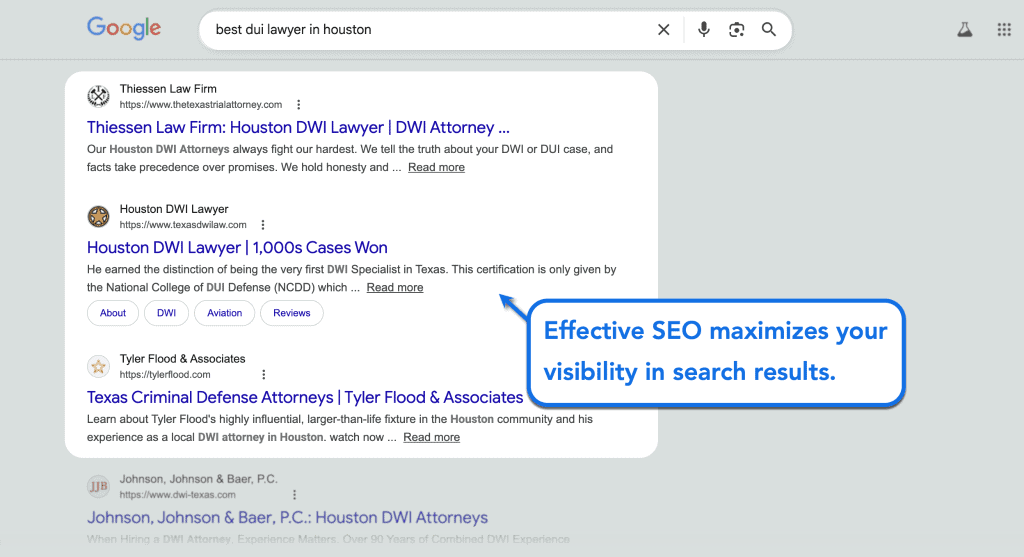
SEO involves strategies that improve a website’s rankings in search results, specifically for relevant keywords that a certain type of audience uses.
For DUI law firms, these keywords may include “DUI lawyer near me” or “best DUI law firm in Houston.”
By successfully optimizing for these keywords, you maximize your law firm’s visibility to potential clients who need your help.
Of course, attaining high rankings and establishing a dominant presence in search results isn’t easy.
On average, it takes around six months before you see significant results from your SEO efforts; possibly three if you work with a professional law firm SEO agency.
A team with proven results in the legal industry is essential, especially since SEO success requires a deep understanding of the unique DUI client journey.
Understanding the DUI Buyer Journey
There are three things that differentiate the DUI client:
- Acts fast: Getting charged with a DUI is one of the most stressful things any individual can experience. They won’t wait long to look for reliable legal representation.
- High stakes: DUI is a high-stakes legal issue even for first-time offenders, possibly resulting in jail time and a license suspension. As such, presenting your firm as authoritative through high Google rankings is a must.
- Hate friction: DUI clients are already overwhelmed with immediate challenges, often including vehicle impounding and license confiscation. To win over clients, promote a frictionless and painless process from the moment they have to book a consultation.
The first 24 hours in the DUI buyer journey are critical for law firms.
During the first day, it’s all about your immediate visibility and accessibility. In terms of SEO, you can prioritize transactional, informational, and local search intent (e.g., “what to do after a DUI arrest in NYC” and “best DUI lawyer near me”).
Days two and three are when the initial shock wears off, which means clients are ready for more in-depth research. This is where your firm’s legal expertise and credentials shine, usually through high-quality, in-depth SEO content.
Laying the Foundation with Local SEO
In terms of building visibility, local SEO offers the fastest and most efficient results.
That is, if you have a time-tested and strategic approach.
The first step is to claim and optimize your Google Business Profile listing. This kickstarts your firm’s visibility in local search results, including search features like the Local 3-Pack and Google Maps.
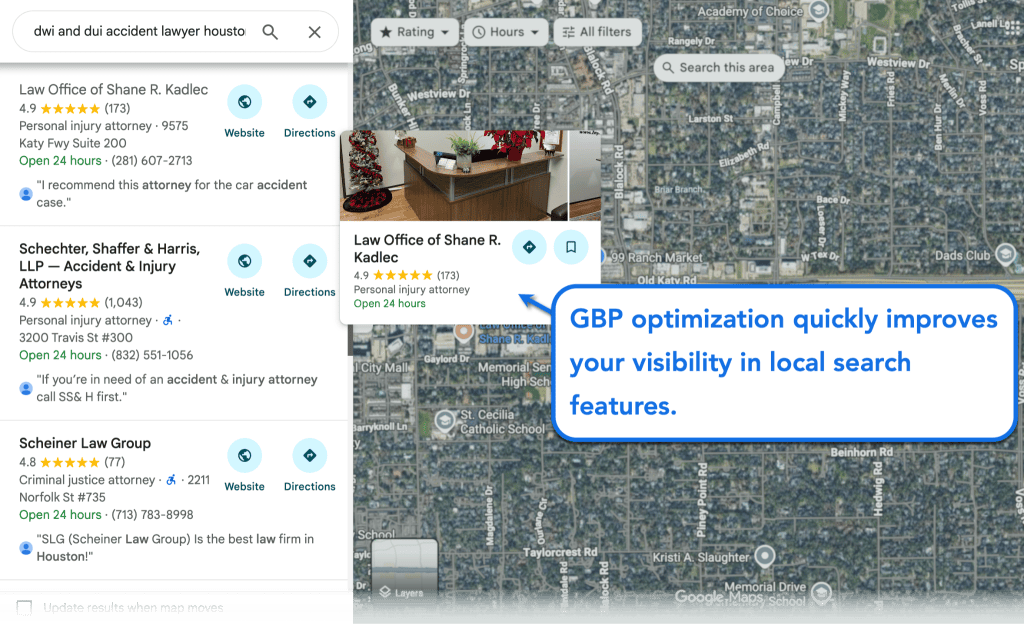
Here’s a quick breakdown of the GBP optimization steps that every DUI law firm should remember:
- Use consistent Name, Address, and Phone (NAP) details: Build your firm’s credibility and local search presence by using the exact same NAP details across channels. This includes your GBP, website, attorney directory listings, and social media.
- Pick the right category: Pick “criminal justice ” or just “law firm” (if more preferable) as your business category. This ensures you’re pulled up for relevant queries.
- Optimize your business description: Describe your legal services and what DUI clients can expect from your firm. Ideally, your description should naturally mention your main keyword (i.e., “DUI attorney in Los Angeles”).
- Add useful content: Regularly post updates, insightful articles, and announcements to signal firm activity. Provide answers to common questions to showcase your expertise to potential clients.
- Accumulate positive reviews: Invite your past clients to leave reviews on your Google Business Profile to build the confidence of prospects. Just remember to respond to reviews in a professional manner, regardless if they’re positive or negative.
In addition to GBP optimization, local SEO also involves claiming and optimizing your listings in legal directories. This includes Avvo, Justia, FindLaw, and LawInfo.
Finally, publish content that covers local news, events, and topics relevant to the legal space. This will show that you’re tapped into the pulse of the local community, greatly improving your firm’s authority and trustworthiness in the eyes of your target audience.
Organic SEO for DUI Lawyers: Step-By-Step Guide
Implementing local SEO positions you for fast and sustainable organic growth. Done right, you should be able to land a few leads with pure local SEO.
But that’s just the beginning.
Keep your momentum going and reap the full benefits of SEO with these steps:
1. Target High-Intent Keywords
Keyword research is an essential first step in any SEO campaign.
The goal is to make sure you’re targeting search users who are actually looking for lawyers who specialize in DUI.
You want high-intent keywords like “best DUI attorney in [City]” or “DUI lawyer near me,” which are queries that potential clients use when they urgently need legal representation.
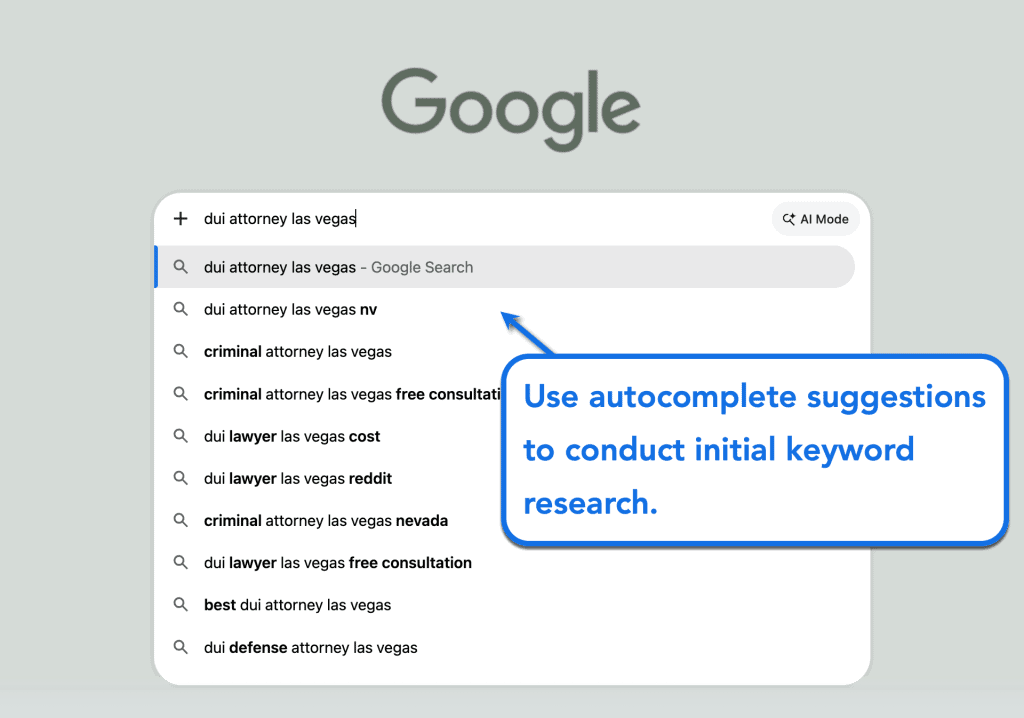
Scanning Google’s autocomplete suggestions is a great way to conduct initial keyword research. It reveals popular, high-volume queries that start with the seed keywords you enter, like “DUI lawyer Las Vegas.”
Of course, you need to go a step further in order to find high-intent SEO keywords that drive profitable results.
Using a tool like Ahrefs or Semrush, you need to refine your keywords into more specific, long-tail variations. This will reveal more keyword ideas that have transactional or commercial intent, helping expand the scope of your SEO strategy.
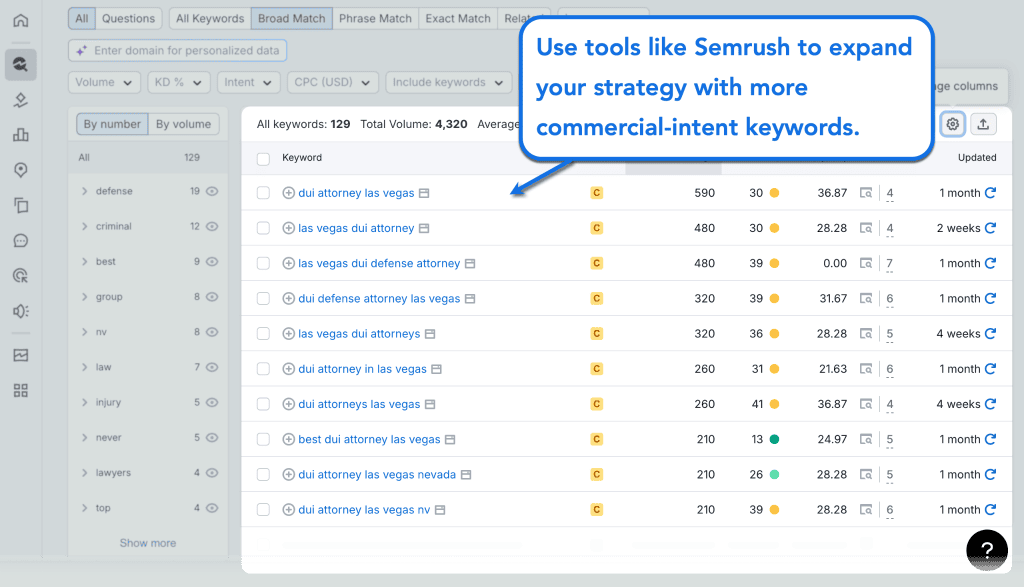
Just remember the following when conducting in-depth keyword research:
- Look for low Keyword Difficulty (KD) opportunities: Avoid going head-to-head against competitors, preferably with a KD% of 49 or below (if you’re using Semrush).
- Target high-intent keywords: Make sure to pick keywords with transactional or commercial intent to attract search users who are more likely to become leads.
- Check other keyword varieties: Look for question-based keywords (i.e., “what is” keywords), phrase match, and related keyword suggestions to diversify your keyword pool and expand your potential organic traffic.
2. Implement Mobile-First Design
In case you didn’t know, more than half of online search traffic now comes from mobile users.
Data from Statista reveals that mobile devices have a 52.27% share of mobile traffic.
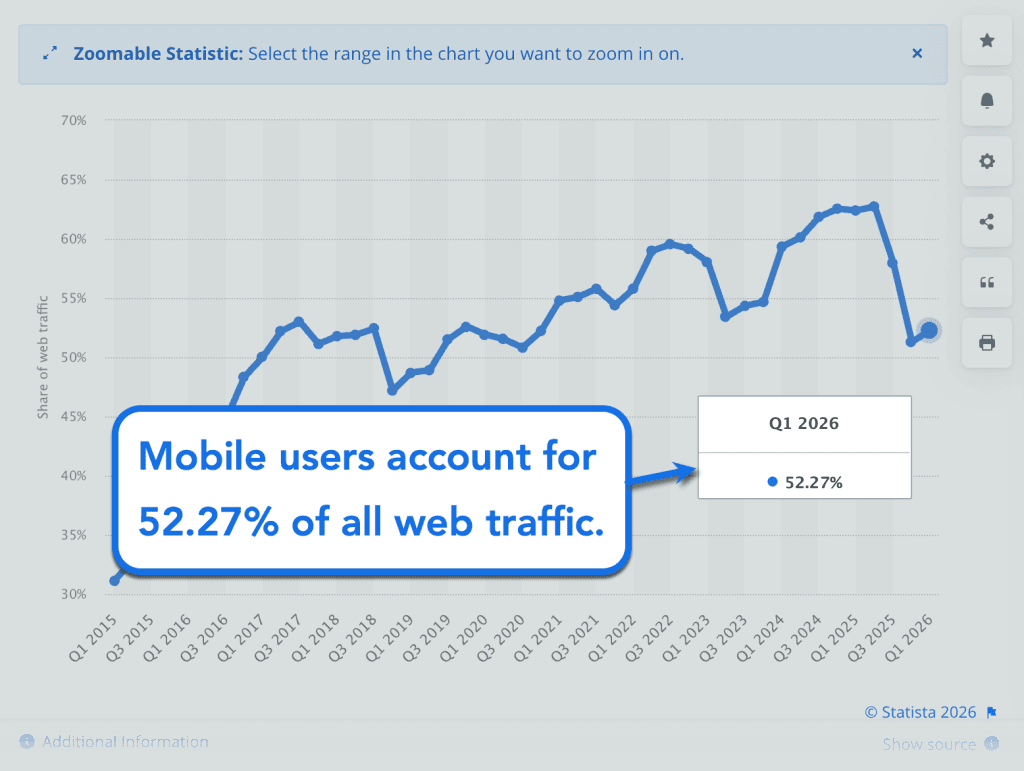
It only makes sense that mobile SEO should be any law firm’s priority over desktop optimization.
Start by implementing mobile-first website design. The usual approach is to use a responsive website layout, which automatically adjusts and resizes based on the user’s screen size.
The good news is, most website platforms like WordPress and Webflow are built with mobile-responsiveness in mind. Each comes with its own library of themes, layouts, and plugins or apps that are optimized for dynamic screen sizes right off the bat.
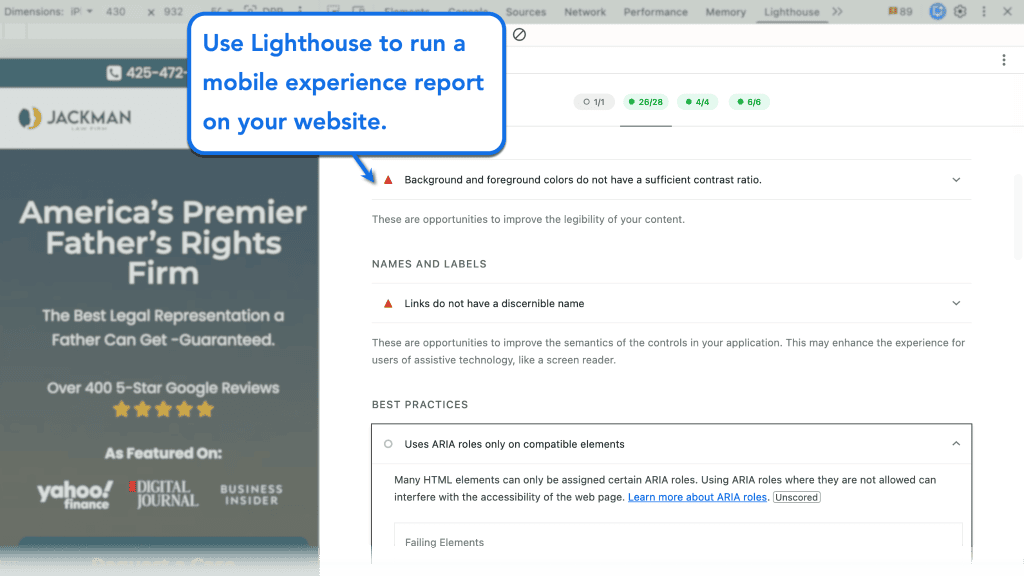
To perform a deeper analysis of your website’s mobile usability and accessibility, generate a report using tools like Lighthouse. This can provide your team with a list of actionable, mobile optimization recommendations based on a real-time analysis of your website.
3. Optimize Website Performance
Another reason to use assessment tools like Lighthouse is to measure website performance metrics, which affect loading speed, responsiveness, and visual stability.
Remember, website performance is a confirmed ranking factor.
If performance analysis is your main priority, use an on-demand reporting tool like PageSpeed Insights instead. Just enter your website’s URL, click ‘Analyze,’ and wait for the tool to pull up your Core Web Vitals metrics:
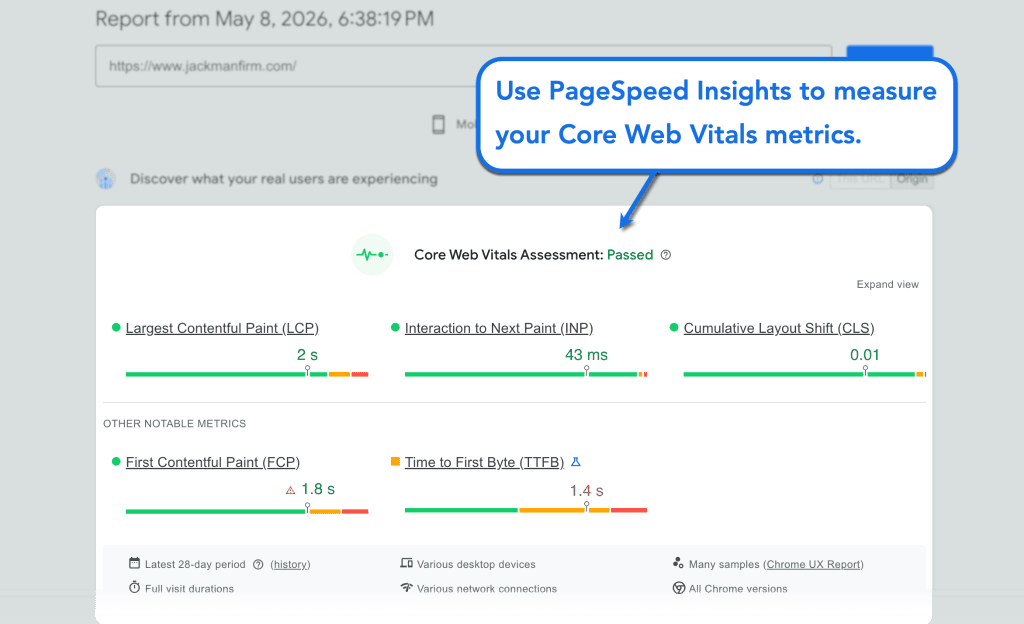
Not sure what these values mean?
Here’s a quick overview of the most important Core Web Vitals metrics you should track:
- Largest Contentful Paint (LCP): Measures (in seconds) the time it takes to load and render the biggest content element or section on your web page.
- Interaction to Next Paint (INP): Measures the delay immediately after a key interaction (e.g., keypress, taps, or mouse click) before the next frame is loaded in.
- Cumulative Layout Shift (CLS): Measures the impact and movement distance between unstable elements on a page during loading (i.e., menu being pushed down once the website’s banner loads).
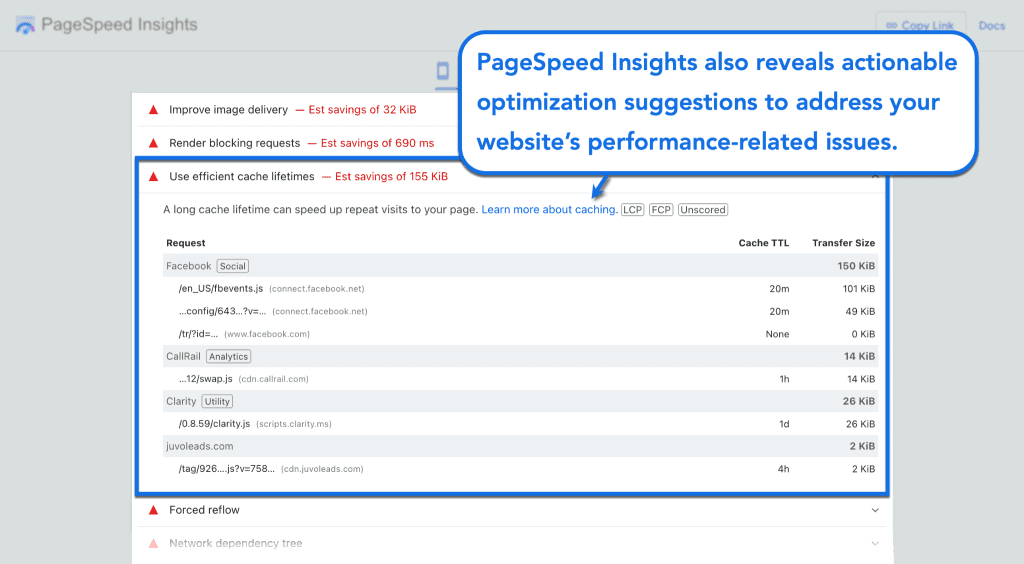
In addition to monitoring these metrics, PageSpeed Insights also underlines the exact issues dragging your website’s performance down. This includes actionable recommendations that directly address these issues, essentially giving you a to-do list for unlocking your website’s full performance potential.
4. Establish E-E-A-T Signals
In modern SEO, publishing high-quality content that addresses your audience’s needs is no longer enough.
You also need to prove that you have the background and authority to provide expert advice.
For DUI attorneys, this means showing your educational background, accomplishments, awards, and associations.
This can be done by publishing attorney bios on your website while attributing content to them through the author Schema markup. Just be sure to use the Schema validator tool to check if the tags are set up correctly.
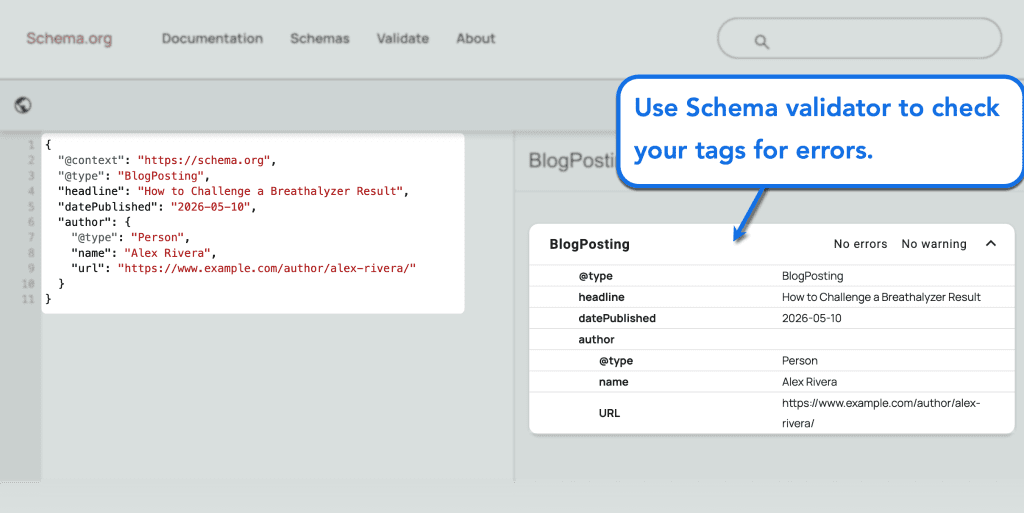
Apart from using markups, your blog content itself should be optimized for E-E-A-T.
As a rule of thumb, your content shouldn’t only contain generic information that’s already found everywhere. Make your content unique by incorporating real-life experiences, using original visuals (i.e., photos), and framing events from the lawyer’s personal perspective.
5. Define Content Publishing Strategy
With your attorney bios all set up, it’s time to put your focus into consistently publishing high-quality content.
Consistent blogging is what separates law firms that dominate organic results from those that rely on ads or local search queries to get traffic.
A fundamental strategy is to build a pillar page specifically for DUI law in a broad sense. This will serve as the starting point or gateway, guiding your audience to more in-depth articles about specific topics (cluster post).
Below is an example topic cluster structure for criminal defense law firms:
- Pillar Page: “DUI law in Atlanta GA”
- Cluster Post #1: “Field Sobriety Tests in GA”
- Cluster Post #2: “What are my rights after being arrested for DUI?”
- Cluster Post #3: “How to find a DUI lawyer in GA”
- Pillar Page: “Drug Offenses in GA”
- Cluster Post #1: “Constructive vs actual possession differences”
- Cluster Post #2: “Defenses against drug possession charges”
- Cluster Post #3: “Diversion programs for first-time offenders”
Keyword research will be your primary tool for building your content cluster strategy.
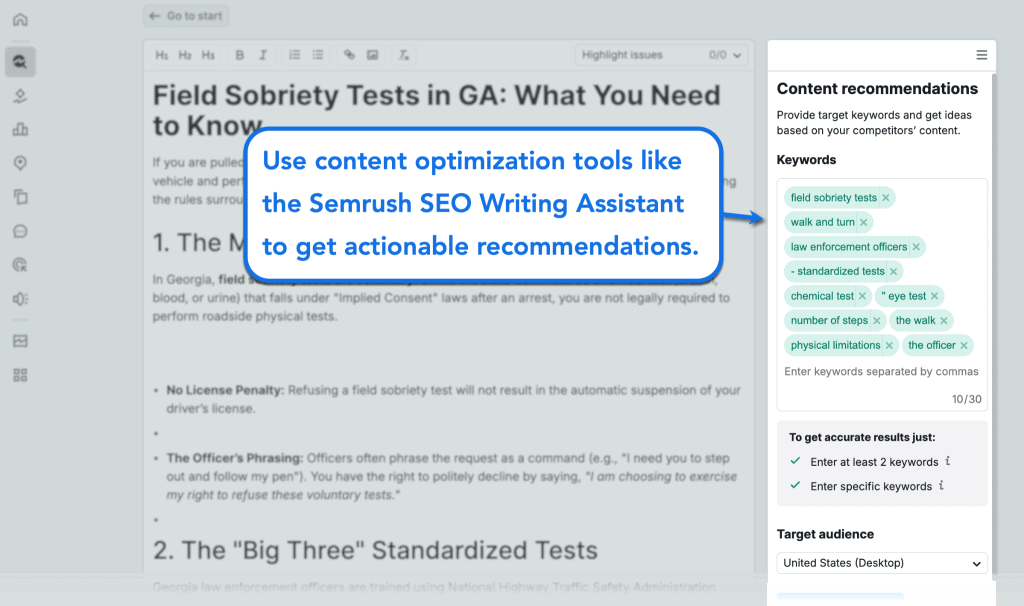
To get higher rankings, consider investing in content optimization tools like Surfer or Semrush SEO Writing Assistant. This will provide you with an actionable checklist of content optimization tips that will maximize rank-worthiness.
6. Map Your Internal Link Structure
When creating content clusters, you can’t forget about internal links.
These are essentially what connect related pages on your website, helping readers and search engine crawlers discover more of your content.
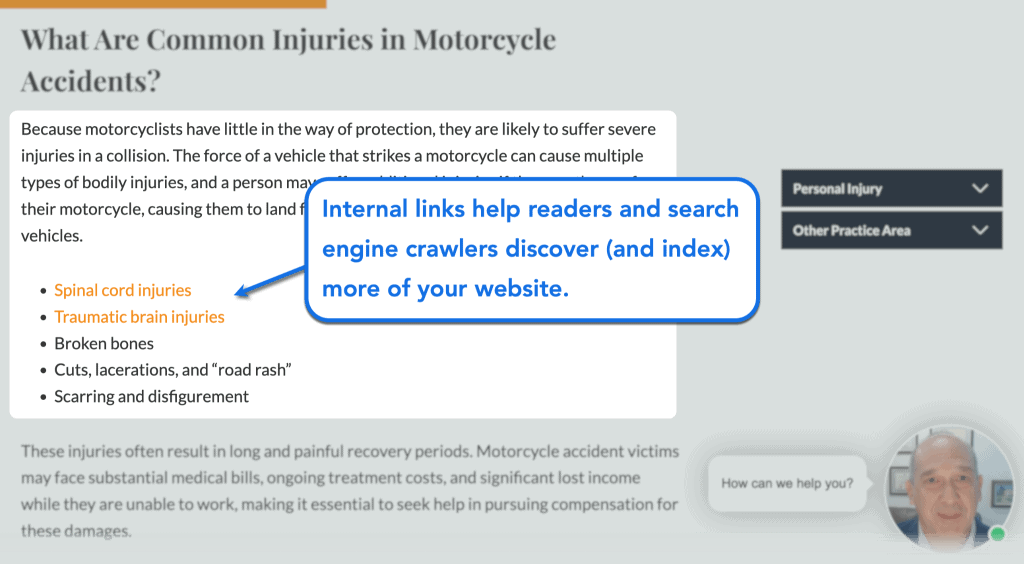
Just remember the following guidelines when building your DUI website’s internal link structure:
- Ensure your pillar pages have easy-to-find internal links to every related cluster post.
- In turn, every cluster post should link back to its pillar page.
- Related cluster posts should also link to one another wherever it matters.
Pro tip: Run a site audit with tools like Ahrefs and Semrush to find internal link issues on your website. This includes “orphaned” pages (without links pointing to them), broken links (404 error), and redirect chains.
7. Conduct Competitor Research
While site audits identify SEO issues and opportunities on your own website, competitor research reveals which strategies are actually proven to drive positive results.
The idea is to understand which keywords, backlink sources, and content topics actually bring attention and engagement to your top competitors. This will eliminate any guesswork and much of the trial-and-error involved in composing an SEO strategy from scratch.
For this, you need an SEO tool with a domain competitor analysis feature. Semrush, for example, generates domain overview reports that contain key insights on your competitor, like their top organic keywords, backlink sources, and indexed pages with the most backlinks.
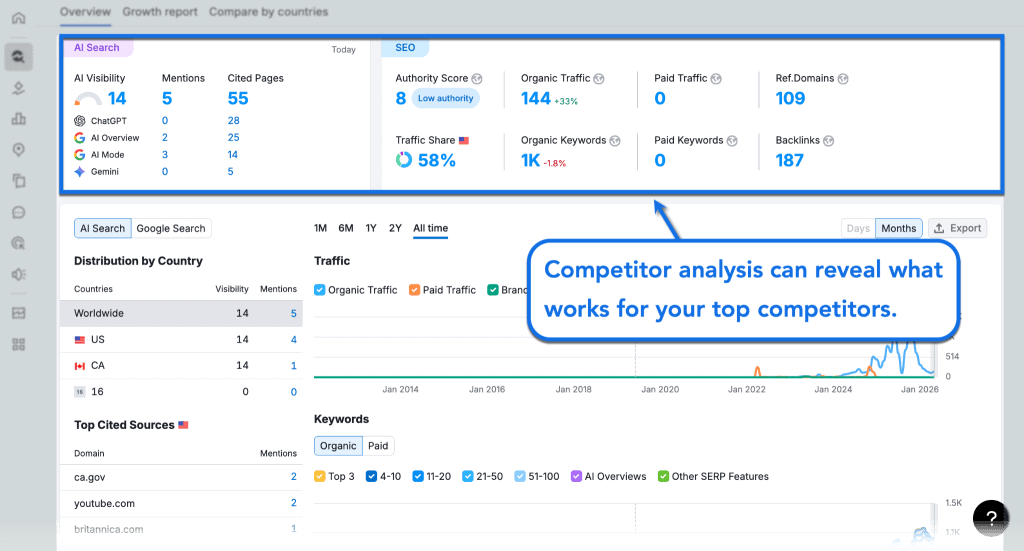
Follow this simple checklist when running SEO competitor analysis for DUI law firms:
- Start your research with the top-ranking DUI law firms in your city or region.
- Review their top-performing and most optimized pages (e.g., homepage or DUI law landing page) for structure, keywords, unique sections, and CTA placements.
- Use domain analysis to reveal other competitors you may have initially overlooked.
- If available, use a gap analysis tool to figure out strategies (e.g., keywords and content topics) that multiple competitors have, but you don’t.
8. Track Analytics
While you conduct competitor analysis, it’s also important to check the data regularly to keep up with changes and spot new opportunities over time.
Remember, analytics doesn’t only mean SEO metrics like keyword rankings and backlinks. You also need to track website performance metrics (i.e., Core Web Vitals) and more specific Key Performance Indicators (KPIs) that justify ROI.
Here are some examples:
- Organic leads generated: Calls, form submissions, consultation bookings, and live chat queries originating from organic search.
- Organic landing page conversion rate: The likelihood of visitors converting into leads after arriving at your SEO landing page.
- Revenue: The increase in revenue driven directly by SEO results.
- Bounce rate: The percentage of organic visitors who exit your website without clicking anything.
Balancing SEO + PPC
Although SEO and Pay Per Click (PPC) advertising represent two different aspects of search marketing, they actually work great together.
While SEO may take several weeks to generate measurable results, PPC can deliver progress overnight. That is, if you set up and optimize your campaign properly, you can fast-track your firm’s visibility in Search Engine Results Pages (SERPs).
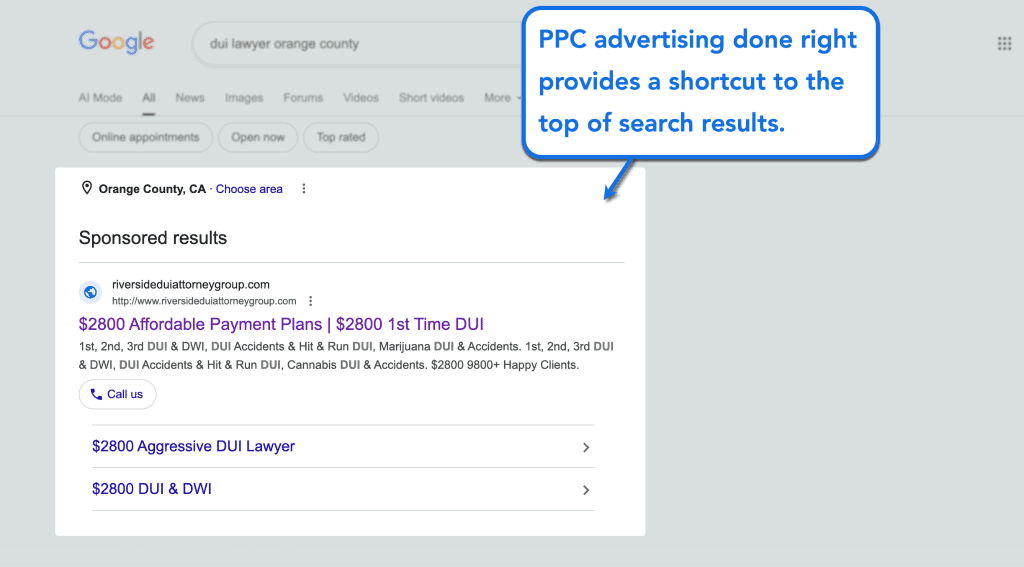
This makes PPC useful for immediate case acquisition while SEO lays the foundation for long-term authority and reduced acquisition costs in the long haul.
Here’s a practical budget allocation framework for DUI law firms:
- New and smaller firms: 70-80% to PPC, 20-30% to SEO
- Growing firms with momentum: 50% PPC, 50% SEO
- Established law firms: 20-40% PPC, 60-80% SEO
Compliance Considerations for DUI Lawyers
Finally, keep in mind that lawyers are held to higher standards when it comes to producing marketing materials. That includes SEO content and PPC ad copy.
So, before you commit to your SEO or PPC campaign, here’s a rundown of the advertising rules you need to remember as a DUI lawyer:
- In no way, shape, or form should you imply that you offer guaranteed wins to prospective leads.
- Avoid making unfair comparisons with terms like “the best,” “most popular,” “most successful,” and other superlatives unless you have substantial and verifiable evidence.
- Make sure testimonials, while they may be 100% truthful and authentic, should be accompanied by a disclaimer similar to “past results don’t guarantee similar outcomes.”
- Don’t mention or imply that you’re a “certified” expert or specialist unless backed by an ABA-accredited organization or state authority.
- If you use AI for content generation, conduct exhaustive checks to make sure they’re free from false information or “hallucinations.”
Final Words
Criminal justice attorneys have a repertoire of well-honed skills that can help people overcome legal challenges.
Unfortunately, SEO isn’t one of those skills.
With the guide above, it’s more than possible for any firm to achieve meaningful SEO and PPC results. But it will be extremely difficult to make a dent in your practice, especially if you have competitors who are prioritizing SEO.
That’s where we come in.Contact us here and let’s discuss how SEO can elevate your firm to the next level.
Related Post
-

Bankruptcy Lawyer Marketing: SEO, Ads & Local Search
Most legal matters don’t carry the kind of stigma bankruptcy does, and that changes how people search for help. Someone in debt might sit on… -
The Ultimate Guide to Immigration Law Firm Marketing & SEO
Immigration legal matters carry intense personal stakes and tight regulatory deadlines. Whether an employer needs a key executive transferred or a family faces an unexpected… -
Spanish SEO For Lawyers: Why It Matters in 2026
Failing to target the rapidly growing Spanish-speaking demographic means you’re losing a lot of qualified cases to local competitors. Spanish speakers and bilingual audiences hold…